
Worksheet 8-2: Orthogonal Projection (with Solutions)#
Download: CMSE382-WS8_2.pdf, CMSE382-WS8_2-Soln.pdf
Warning
This is an AI-generated transcript of the worksheet and may contain errors or inaccuracies. Please refer to the original course materials for authoritative content.
Worksheet 8-2: Q1#
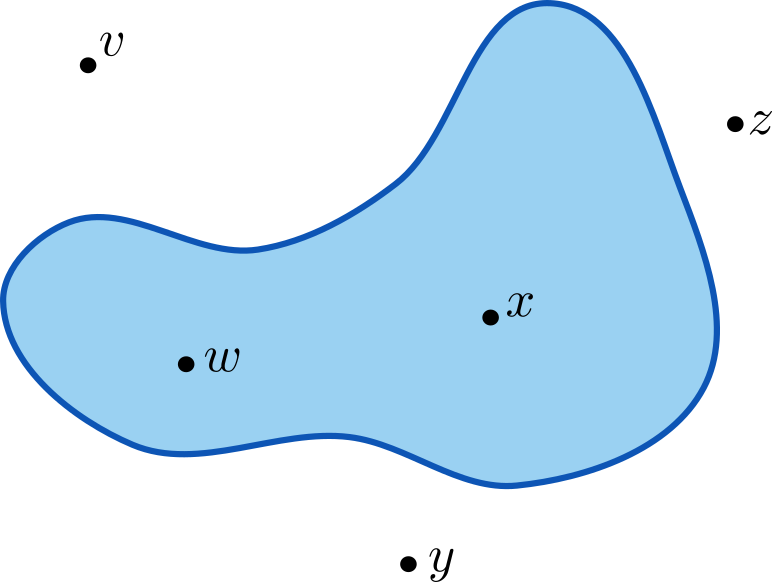
For the following sets and each point drawn (\(v\), \(w\), \(x\), \(y\), and \(z\)), mark the point that minimizes the projection operator (\(P_C(v)\), \(P_C(w)\), \(P_C(x)\), \(P_C(y)\), and \(P_C(z)\)).
Solution

Worksheet 8-2: Q2#
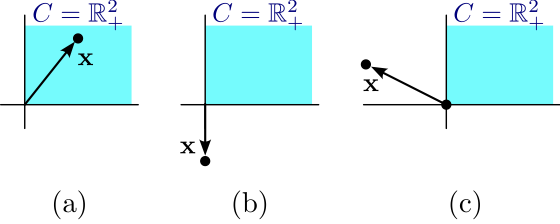
For each of the shown vectors \(\mathbf{x}\), answer the following
Find an expression for the non-negative real part \([\mathbf{x}]_+\) in terms of \(\mathbf{x} = (x_1,x_2)\).
Solution
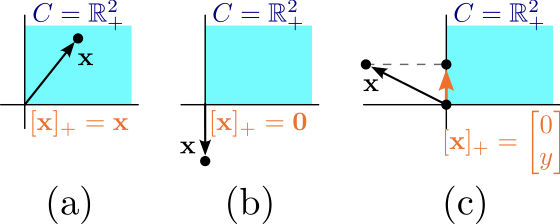
(a) The point is already in the non-negative orthant, so \([\mathbf{x}]_+ = \mathbf{x}\).
(b) The point is in the negative orthant, so \([\mathbf{x}]_+ = \mathbf{0}\).
(c) \(x_1\) is negative and \(x_2\) is positive, so \([\mathbf{x}]_+ = (0,x_2)\).
Sketch \([\mathbf{x}]_+\) for each vector.
Solution
Worksheet 8-2: Q3#
Consider the set \(C = \{(y_1,y_2,y_3) \in \mathbb{R}^3 \mid y_1\geq 0, y_2\geq 0, y_3 = 0 \}\). Write the orthogonal projection operator \(P_C(\mathbf{x})\) for any \(\mathbf{x} = (x_1,x_2,x_3) \in \mathbb{R}^3\). What point in \(C\) minimizes \(P_c(\mathbf{x})\)? Write it in terms of \([\cdot]_+\) if possible.
Solution
The projection operator is \(P_C(\mathbf{x}) = \mathbf{y}\) where \(\mathbf{y}\) minimizes
which is equivalent to
This is separable, so the projection is the point \((y_1,y_2,y_3)\) that minimizes \((y_1-x_1)^2\), \((y_2-x_2)^2\), and \((x_3)^2\) separately (since \(y_3=0\)).
This means the point in \(C\) that minimizes both functions is \(P_C(\mathbf{x}) = ([x_1]_+, [x_2]_+, 0)\).
For each of the following points, write the expression for the projected point in terms of just \(x_1, x_2, x_3\). Sketch the point.

Solution
(a) Since \(x_1, x_2, x_3 \geq 0\), we have
(b) Here, \(x_1, x_3 \geq 0\), but \(x_2 \leq 0\). So we have
(c) In this case, \(x_1,x_2,x_3 \leq 0\), so
Worksheet 8-2: Q4#
A box is a subset of \(\mathbb{R}^n\) of the form
where \(\ell_i \leq u_i\) for all \(i=1,2,\ldots,n\).
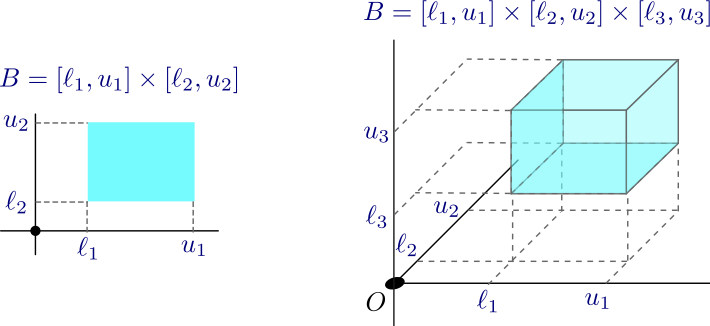
We will assume that some of the \(u_i\)s can be \(\infty\) and some of the \(\ell_i\)s can be \(-\infty\); but in these cases we will assume that \(-\infty\) or \(\infty\) are not contained in the intervals. The figure above shows some two examples in boxes in \(\mathbb{R}^2\) and \(\mathbb{R}^3\). The orthognal projection on the box is the minimizer of the convex optimization problem
for a given box \(B\).
Write the minimization problem above in terms of only \(x_i\)’s and \(y_i\)’s.
Solution
Is the resulting functional equation separable? Justify your answer.
Solution
Yes it’s separable. This is exactly the definition since I have the function in pieces that each only depend on one of the constraints.
Write down and solve the optimization problem for each \(y_i\). Use this to determine \(\mathbf{y} = P_C(\mathbf{x})\).
Solution
The problem becomes
which has value 0 if \(x_i \in [\ell_i,u_i]\) since we just set \(y_i = x_i\). On the other hand, if \(x_i<\ell_i\), the minimum occurs at the lower bound \(y_i = \ell_i\), and similarly if \(x_i>u_i\), it occurs at \(y_i = u_i\). Putting this together, the optimum is at
and so the full solution is \(\mathbf{y} = (y_1,\cdots,y_n)\) for the \(y_i\)’s given above.
Worksheet 8-2: Q5#
Consider the normal ball in \( \mathbb{R}^2\), \(C = B[0,r] = \{\mathbf{y} =(y_1,y_2) \mid \|\mathbf{y}\|_2 \leq r\}\). We will find the projection \(P_C(\mathbf{x})\) for some point \(\mathbf{x} \in \mathbb{R}^2\), which is the \(\mathbf{y}\) that minimizes
Assume \(\mathbf{x} \in B[0,r]\). What is \(P_C(\mathbf{x})\) and why?
Solution
\(P_C(\mathbf{x}) = \mathbf{x}\) since \(\|x \leq r^2\) as it’s in \(B[0,r]\), so then the function becomes
and this function is always \(\geq 0\), so this must be the minimum.
What is \(\nabla f(\mathbf{z})\) for \(f(\mathbf{z}) = \|\mathbf{z}\|^2\)?
Solution
This works for any dimension, but we’re just focused on \( \mathbb{R}^2\) right now. So think of \(f(z_1,z_2) = z_1^2 + z_2^2\) to write the gradient as
Now we can deal with the case where \(\mathbf{x} \not\in B[0,r]\), equivalently \(\|\mathbf{x}\|^2 \geq r^2\). We know (from the first order optimality condition for local optima, Thm 2.6 in the book) that if \(\mathbf{x}^* \in \text{int}(C)\) is a local optimum and all partial derivatives exist, then \(\nabla f(\mathbf{x}^*) = 0\). If \(\mathbf{x} \not\in B[0,r]\) and somehow \(\mathbf{x}^* = P_C(\mathbf{x}) \in \text{int}(B[0,r])\), use your calculated gradient above to conclude that the result is impossible so \(P_C(\mathbf{x})\) must be on the boundary of \(B[0,r]\).
Solution
If \(\mathbf{x}^* = P_C(\mathbf{x}) \in \text{int}(B[0,r])\), the theorem mentioned says that we must have \(\nabla f(\mathbf{x}^*) = 0\). But by the calculation above, this is the optimum of \(f(\mathbf{x}-\mathbf{y}) = \|\mathbf{x}-\mathbf{y}\|^2\), so \(\nabla f = 2(\mathbf{x}^* - \mathbf{x}) = \), but then \(\mathbf{x}^* = \mathbf{x}\). The problem is \(\mathbf{x} \not \in B[0,r]\) but \(\mathbf{x}^* \in B[0,r]\), so they can’t be the same point. This means that our assumption that \(\mathbf{x}^*\) was in the interior of \(B[0,r]\) must be wrong, so \(\mathbf{x}^*\) is on the boundary.
By the previous, we know that if \(\|\mathbf{x}\|\geq r\), the solution must be on the boundary, so we can replace the problem with
Then I can expand \(\|\mathbf{y}-\mathbf{x}\|^2 = \|\mathbf{y}\|^2 -2 \mathbf{y}^\top \mathbf{x} + \|\mathbf{x}\|^2\) and replace this problem with
Why, then, can I replace this problem with the following problem?
Solution
We know that \(\|y\|^2 = r^2\) is a constant that doesn’t depend on \(\mathbf{y}\). Also, \(\|\mathbf{x}\|^2\) doesn’t depend on \(\mathbf{y}\). So \(\|\mathbf{y}\|^2 + \|\mathbf{x}\|^2\) is a constant as far as \(\mathbf{y}\) is concerned. So the optimization will find a minimum at the same \(\mathbf{y}\) whether we use
or just \(-2 \mathbf{y}^\top \mathbf{x}\).
The Cauchy-Schwartz inequality (\(|\mathbf{u}^\top \mathbf{v}| \leq \|\mathbf{u}\| \cdot \|\mathbf{v}\|\)) gives us a bound
Use the above to justify each inequality below.
Solution
The first inequality comes from multiplying the top equation by \(-2\) and reversing the inequality because it’s negative. The second equality is because \(\mathbf{y}\) is on the boundary of the ball, so \(\|\mathbf{y}\| = r\).
Check that equality in Eqn. (bound) (meaning \(-2 \mathbf{y}^\top \mathbf{x} = -2r\|\mathbf{x}\|\)) occurs when \(\mathbf{y}^* = r\frac{\mathbf{x}}{\|\mathbf{x}\|}\).
Solution
Notice we can just drop the \(-2\) on each side to see if \(\mathbf{y}^\top \mathbf{x} = r\|\mathbf{x}\|\). Plugging in \(\mathbf{y} = \mathbf{y}^*\) on the left gives
Check that \(\mathbf{y}^* = r\frac{\mathbf{x}}{\|\mathbf{x}\|}\) is in \(B[0,r]\).
Solution
In this case, we just need to be sure it is on the boundary, so I need \(\|\mathbf{y}^*\|^2 = r^2\). But we can check this since
like we wanted.
Putting the above together, fill in the orthogonal projection for the ball: