
Lecture 2-1: Optimality Conditions#
Download the original slides: CMSE382-Lec2_1.pdf
Warning
This is an AI-generated transcript of the lecture slides and may contain errors or inaccuracies. Please refer to the original course materials for authoritative content.
Global and Local Optima#
Local Minima#
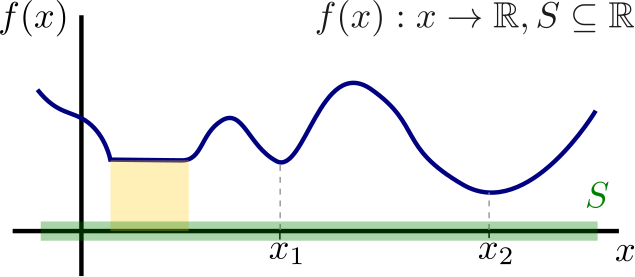
Definition: Let \(f:S \to \mathbb{R}\), where \(S\subseteq \mathbb{R}^n\), then
\(x^*\) is a local minimum over \(S\) if \(\exists r > 0\) such that \(f(x) \geq f(x^*)\) \(\forall x \in S \cap B(x^*,r)\).
\(x^*\) is a strict local minimum over \(S\) if \(\exists r > 0\) such that \(f(x) > f(x^*)\) \(\forall x \in S \cap B(x^*,r)\).
Local Maxima#
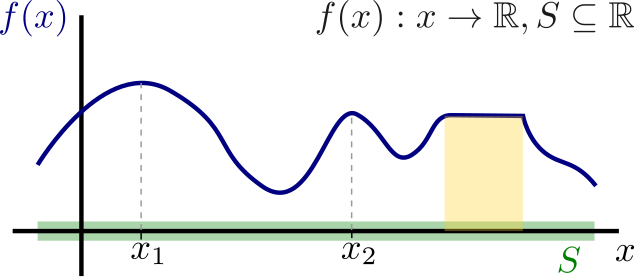
Definition: Let \(f:S \to \mathbb{R}\), where \(S\subseteq \mathbb{R}^n\), then
\(x^*\) is a local maximum over \(S\) if \(\exists r > 0\) such that \(f(x) \leq f(x^*)\) \(\forall x \in S \cap B(x^*,r)\).
\(x^*\) is a strict local maximum over \(S\) if \(\exists r > 0\) such that \(f(x) < f(x^*)\) \(\forall x \in S \cap B(x^*,r)\).
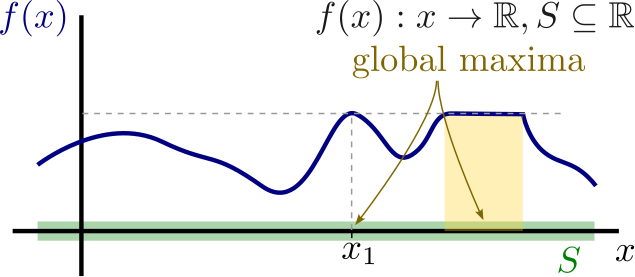
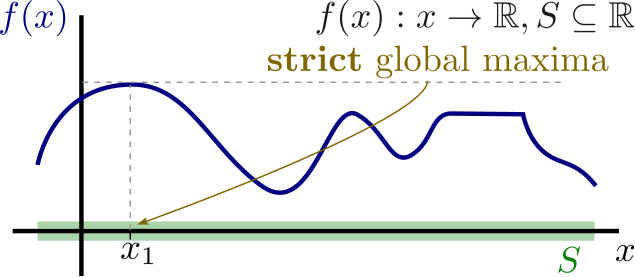
Global Optima#
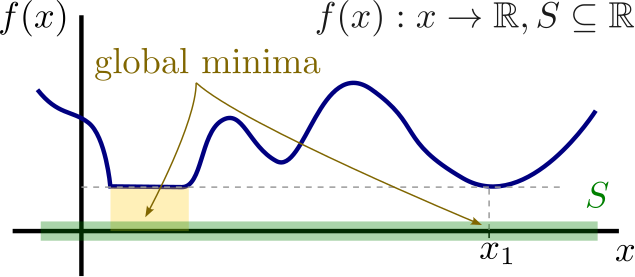
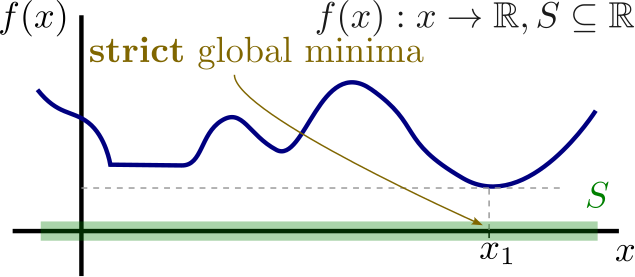
Definition: Let \(f:S \to \mathbb{R}\), where \(S\subseteq \mathbb{R}^n\), then \(x^* \in S\) is a
global minimum over \(S\) if \(f(x) \geq f(x^*)\) \(\forall x \in S\).
strict global minimum over \(S\) if \(f(x) > f(x^*)\) \(\forall x \in S\).
global maximum over \(S\) if \(f(x) \leq f(x^*)\) \(\forall x \in S\).
strict global maximum over \(S\) if \(f(x) < f(x^*)\) \(\forall x \in S\).
Generalized Extreme Value Theorem#
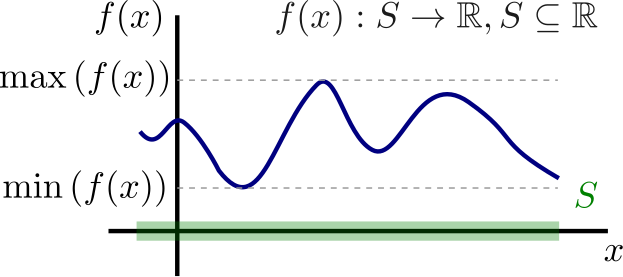
Theorem (Generalized Extreme Value Theorem): Let \(U \subset \mathbb{R}^n\) be a non-empty compact set. If \(f:U \to \mathbb{R}\) is a continuous function, then \(f\) is bounded and there exists \(p,q \in U\) such that \(f(p)=\sup_{x\in U}{f(x)}\) and \(f(q)=\inf_{x\in U}{f(x)}\).
Recall:
A subset of \(\mathbb{R}^n\) is compact if it is closed and bounded.
A set \(U\) is bounded if there exists \(M>0\) such that \(U\subset B(\mathbf{0},M)\), i.e., we can contain the set within a finite open ball.
A set \(U\) is closed with respect to a metric \(d\) if it contains all its limit points, i.e., \(U=\text{Cl}(U)\).
Critical Points#
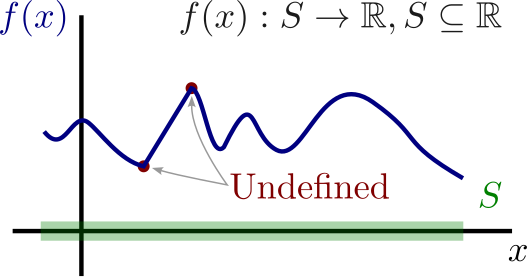
Definition (Critical Points): Let \(f:U \to \mathbb{R}\). A point \(x^* \in U\) is called a critical point of \(f\) if \(\nabla f(x^*)=0\), or if \(\nabla f(x^*)\) is not defined.
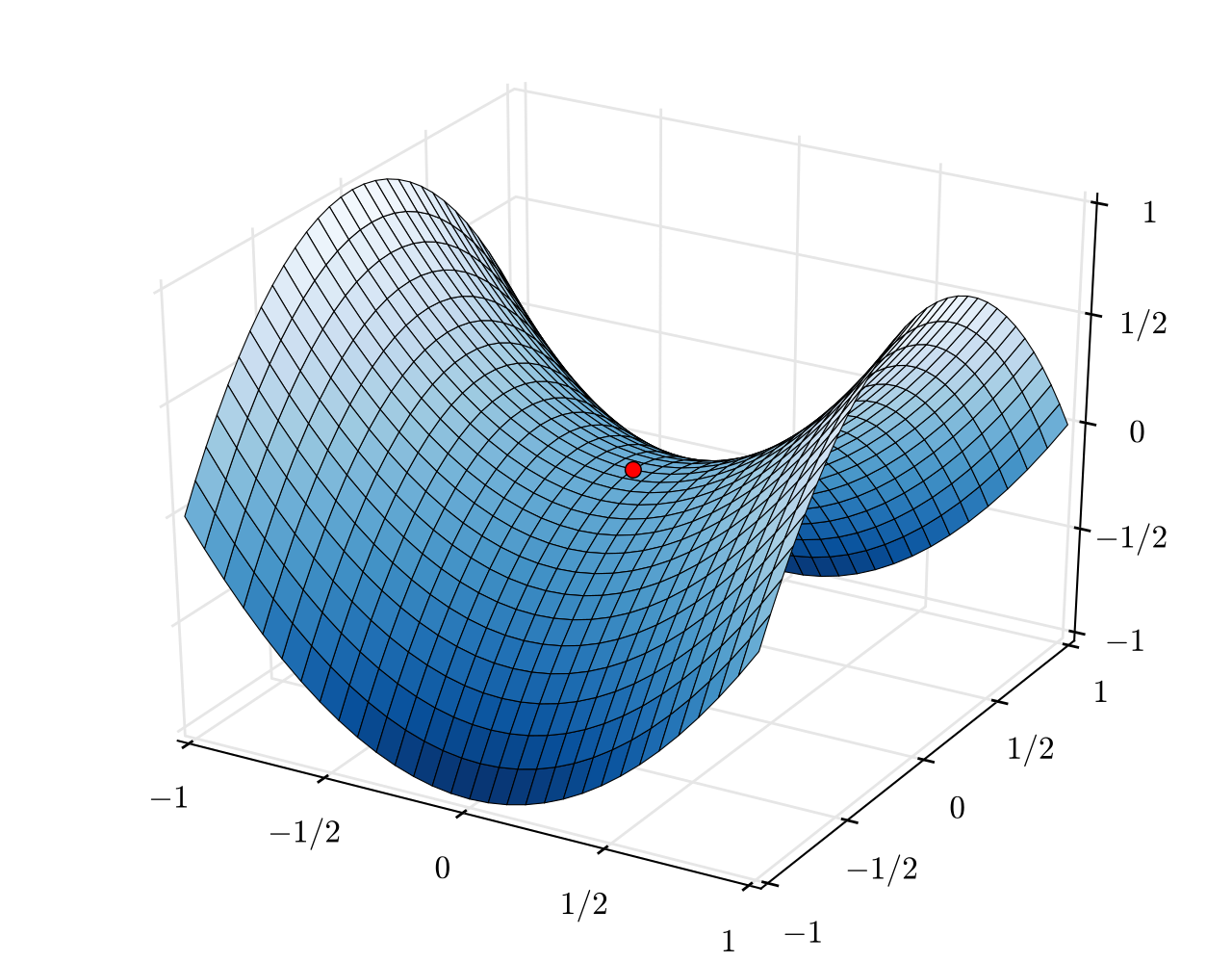
A critical point can correspond to:
\(\nabla f(x^*)\) undefined (including boundary points of \(U\))
local minimum (\(\nabla f(x^*)=0\))
local maximum (\(\nabla f(x^*)=0\))
saddle point (\(\nabla f(x^*)=0\))
Stationary Points#
Definition (Stationary Points): Let \(f:U \to \mathbb{R}\), \(x^* \in \text{int}(U)\), and \(f\) be differentiable over a neighborhood of \(x^*\). Then \(x^*\) is called a stationary point of \(f\) if \(\nabla f(x^*)=0\).
A stationary point can correspond to:
local minimum (\(\nabla f(x^*)=0\))
local maximum (\(\nabla f(x^*)=0\))
saddle point (\(\nabla f(x^*)=0\))
Warning: Stationary points are critical points, but critical points are not necessarily stationary points.
First Order Optimality Condition#
Theorem (First Order Optimality Condition): Let \(f:U\to \mathbb{R}\) be a function defined on \(U\subseteq \mathbb{R}^n\). Suppose \(x^* \in \text{int}(U)\) is a local optimum (minimum or maximum) point and that all partial derivatives of \(f\) exist at \(x^*\).
Then \(\nabla f(x^*)=0\).