Lecture 8-2: Convex Optimization: Part 2#
Download the original slides: CMSE382-Lec8_2.pdf
Warning
This is an AI-generated transcript of the lecture slides and may contain errors or inaccuracies. Please refer to the original course materials for authoritative content.
This Lecture#
Topics:
The orthogonal projection operator
Projection on the non-negative orthant
Projection on \(B[0,r]\)
Announcements:
Homework 4 due Friday
Orthogonal Projection Operator#
Orthogonal projection#
Definition (Orthogonal projection operator)
Given a nonempty closed convex set \(C\), the orthogonal projection operator \(P_C:\mathbb{R}^n \to C\) is defined by
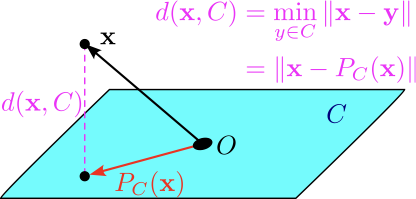
Returns the vector in \(C\) that is closest to input vector \(\mathbf{x}\).
Is a convex optimization problem:
Orthogonal projection: First projection theorem#
Theorem (first projection theorem)
Let \(C\) be a nonempty closed convex set. Then the problem \(P_C(\mathbf{x})=\text{argmin}{\|\mathbf{y} - \mathbf{x}\|^2: \mathbf{y} \in C}\) has a unique optimal solution.
Computing \(P_C(\mathbf{x})\) can be difficult. Examples where it is easy to compute:
Projection on non-negative orthant.
Projection onto balls.
Non-negative part of a vector#
Definition (Non-negative part of a vector)
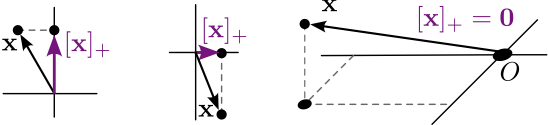
For \(\alpha \in \mathbb{R}\), the non-negative part of \(\alpha\) is \([\alpha]_+ = \begin{cases}\alpha, & \alpha \geq 0\\ 0, & \alpha<0. \end{cases}\)
For a vector \(\mathbf{v} \in \mathbb{R}^n\), the non-negative part of \(\mathbf{v}\) is \([\mathbf{v}]_+ = \begin{bmatrix} [v_1]_+ \\ [v_2]_+ \\ \vdots \\ [v_n]_+ \end{bmatrix}\)
Orthogonal projection: Projection on the non-negative orthant#
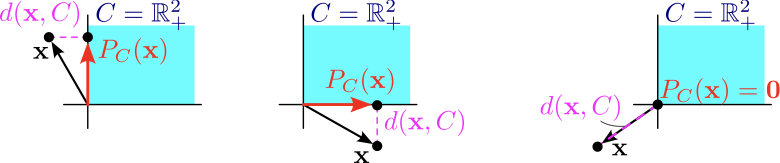
Let \(C=\mathbb{R}^n_{+}\). To find the orthogonal projection of \(\mathbf{x} \in \mathbb{R}^n\) onto \(\mathbb{R}^n_{+}\):
\(\underline{P_C(\mathbf{x})}\)
\(\underline{\text{Equivalently,}}\)
\(\underline{\text{Separable}}\)
Definition (Separable convex optimization problems)
A convex optimization problem is called separable if the objective function and the constraints can be decomposed into components that each depend on one control/decision variable:
Objective function: \(f(\mathbf{x})=\sum{f_i(\mathbf{x}_i)}\).
Constraint(s): \(g(\mathbf{x})=\sum{g_i(\mathbf{x}_i)}\), or \(\{g_i(\mathbf{x}_i)\}_{i}\)
Orthogonal projection: Projection on the non-negative orthant#
Let \(C=\mathbb{R}^n_{+}\). The orthogonal projection of \(\mathbf{x} \in \mathbb{R}^n\) onto \(\mathbb{R}^n_{+} = \{\mathbf{y} \in \R^n \mid y_i \geq 0 \; \forall i\}\) is
Orthogonal projection onto \(\mathbb{R}^n_{+}\)
The orthogonal projection operator onto \(\mathbb{R}^n_{+}\) is
Orthogonal projection: Projection onto balls#
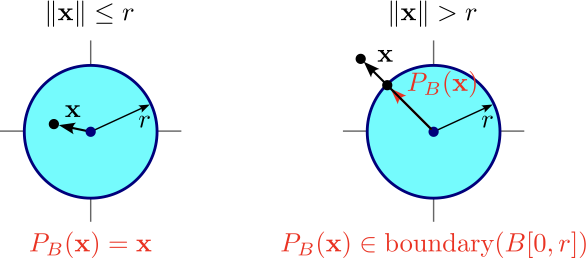
Let \(C=B[\mathbf{0},r]=\{\mathbf{y}:\|\mathbf{y}\leq r\}\). The projection of \(\mathbf{x}\) onto \(C\) is