
Worksheet 6-1: Convex Sets#
Download: CMSE382-WS6_1.pdf
Warning
This is an AI-generated transcript of the worksheet and may contain errors or inaccuracies. Please refer to the original course materials for authoritative content.
Worksheet 6-1: Q1#
Let \(\mathbf{x}_1 = (2,3)^\top\) and \(\mathbf{x}_2 = (1,4)^\top\).
Write the equation of the line passing through \(\mathbf{x}_1\) and \(\mathbf{x}_2\) as a function of \(\lambda\):
\[\mathbf{x}(\lambda) = (1-\lambda)\mathbf{x}_1 + \lambda \mathbf{x}_2\]For each value of \(\lambda\) below, compute the point \(\mathbf{x}(\lambda)\) and state whether it lies on the segment between \(\mathbf{x}_1\) and \(\mathbf{x}_2\), or outside it:
\(\lambda\)
\(\mathbf{x}(\lambda)\)
On segment?
\(\lambda = 0\)
\(\lambda = 1/2\)
\(\lambda = 1\)
\(\lambda = 2\)
Worksheet 6-1: Q2#
For each of the following sets, determine whether it is convex or not convex.
(a) A finite set of points \(S = \{p_1, p_2, \ldots, p_k\} \subset \mathbb{R}^n\) (with \(k \ge 2\)).
(b) The nonnegative orthant \(\mathbb{R}^2_+ = \{(x,y) \mid x \ge 0, y \ge 0\}\) (shown below).
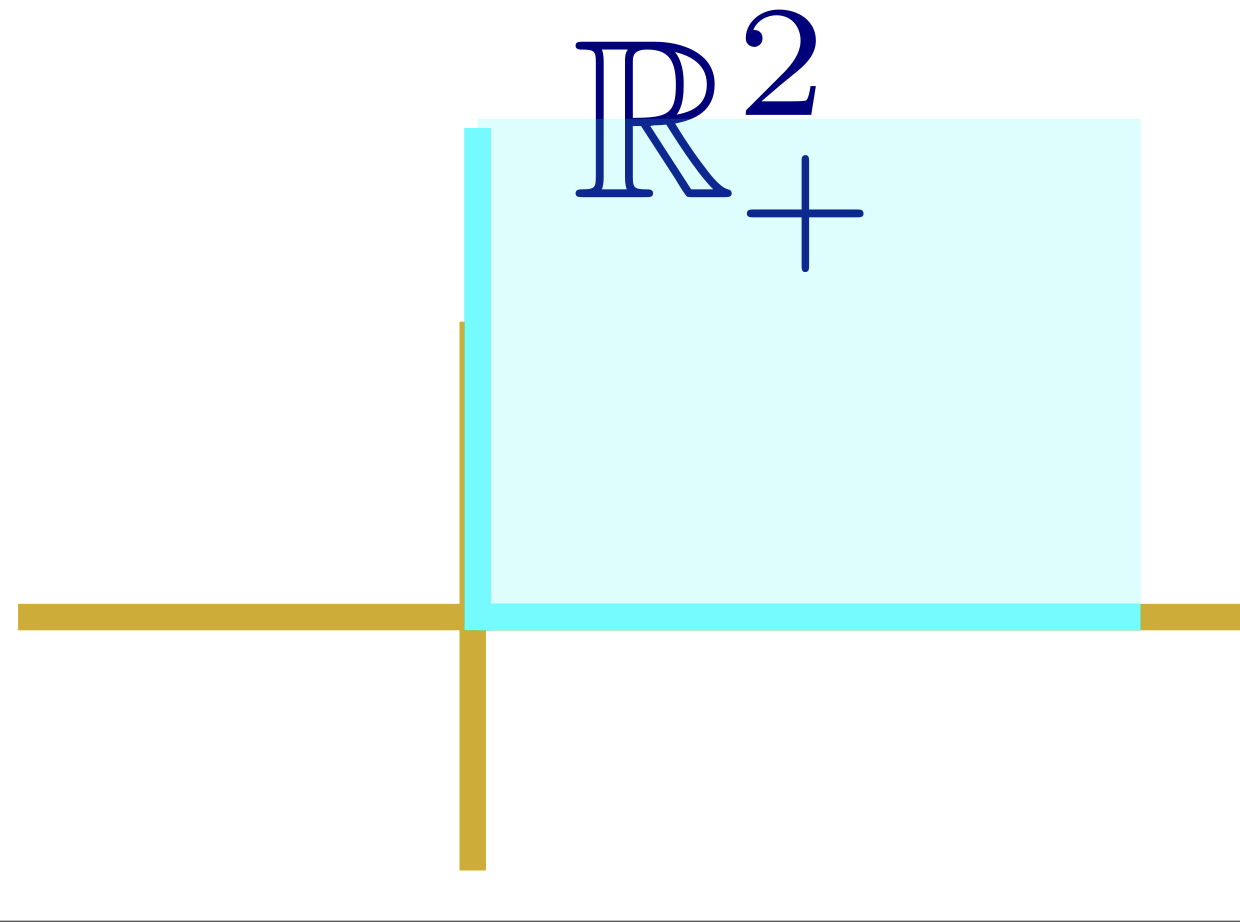
(c) The set \(\{(x,y) \mid xy = 0\}\) (axes, or “L-shape”):
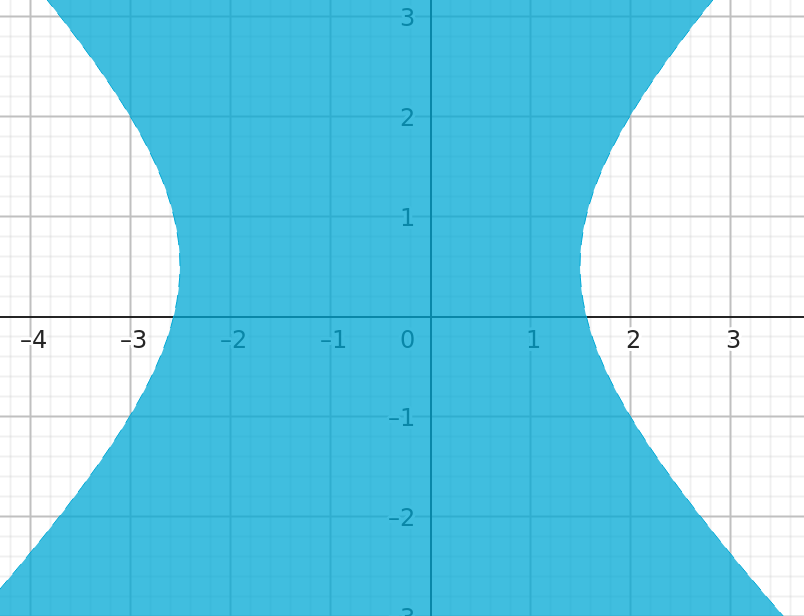
(d) The set shown below (defined by a nonlinear inequality):
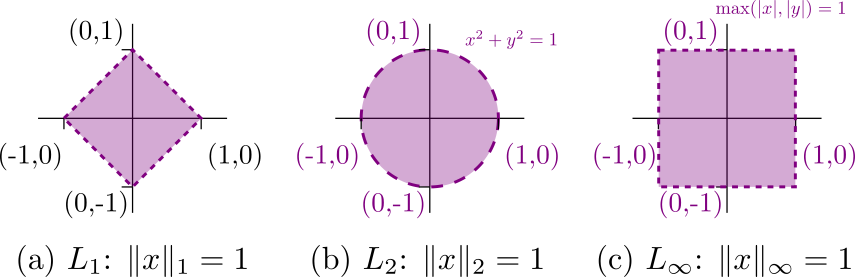
(e) The \(\ell_1\), \(\ell_2\), and \(\ell_\infty\) unit balls in \(\mathbb{R}^2\):
Worksheet 6-1: Q3#
(a) Draw an example of a union of two convex sets that is not convex.
(b) Draw an example of a union of two convex sets that is convex.
Worksheet 6-1: Q4#
Let \(S = \{(1,1), (2,2), (3,1)\}\).
Sketch the convex hull \(\text{conv}(S)\).
For each of the following points, find \(\lambda_1, \lambda_2, \lambda_3 \ge 0\) with \(\lambda_1+\lambda_2+\lambda_3=1\) such that \(\mathbf{x} = \lambda_1(1,1)+\lambda_2(2,2)+\lambda_3(3,1)\):
Point \(\mathbf{x}\)
\(\lambda_1\)
\(\lambda_2\)
\(\lambda_3\)
\((2,2)\)
\((2,1.5)\)
\((1.5, 1.5)\)
\((2, 1)\)
For each set of coefficients below, identify the corresponding point:
\(\lambda_1\)
\(\lambda_2\)
\(\lambda_3\)
Point \(\mathbf{x}\)
\(1/3\)
\(1/3\)
\(1/3\)
\(1/2\)
\(0\)
\(1/2\)
\(0\)
\(1/4\)
\(3/4\)
Worksheet 6-1: Q5#
Let \(S = \{(1,1), (1,2), (2,1), (2,2)\}\).
Sketch \(S\) and its convex hull \(\text{conv}(S)\).
What is the maximum number of points from \(S\) needed to represent any point in \(\text{conv}(S)\) as a convex combination? (Hint: Carathéodory’s theorem.)
Write the point \(\mathbf{x} = (1.5, 1.4)\) as a convex combination of points in \(S\).