
Lecture 1-1: Intro and First Day Stuff#
Download the original slides: CMSE382-Lec1_1.pdf
Warning
This is an AI-generated transcript of the lecture slides and may contain errors or inaccuracies. Please refer to the original course materials for authoritative content.
Course Information#
People in this Lecture#
Prof. Elizabeth Munch (she/her)
Depts of CMSE and Math
Omeiza Olumoye
Graduate Student, CMSE, MSU
What is This Course About?#
Machine Learning Pipeline
Finding the Optimum
There will be calculus! And matrices!
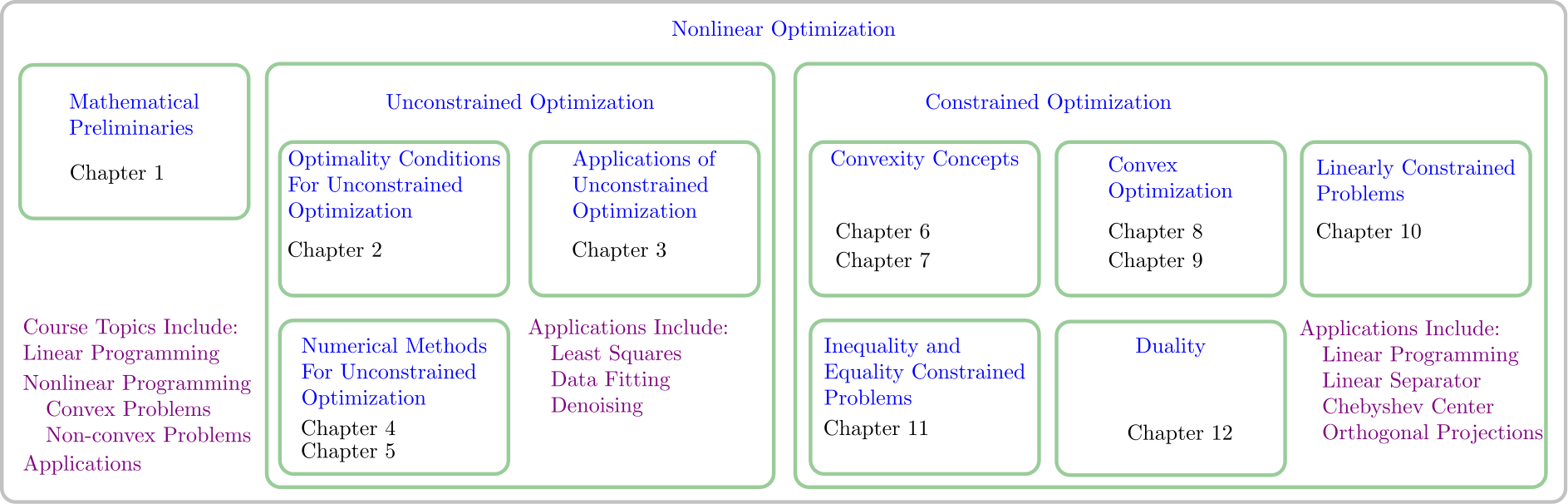
Course Outline#
See: msu-cmse-courses.github.io/cmse382-spring2026/
Course Website#
Course slides and Jupyter notebooks:
https://elizabethmunch.com/CMSE382
— or —
https://msu-cmse-courses.github.io/cmse382-spring2026/
Note the syllabus link above!
D2L and Where to Find Grades#
Crowdmark and Where to Submit Assignments#
You should already have an automated email from the system. If not, talk to the instructor.
Office Hours#
Zoom link and schedule: msu-cmse-courses.github.io/cmse382-spring2026/help/#office-hours
Dr. Munch: Time TBD (Starting next week). Zoom & EGR 1511.
Omeiza Olumoye: Time TBD. Zoom & EGR (Room TBD).
Textbook#
Introduction to Nonlinear Optimization by Amir Beck.
Free download from MSU Library Website.
More info: msu-cmse-courses.github.io/cmse382-spring2026/textbook/
Class Structure#
Most classes have videos to watch before class. These will be posted on the course website and D2L.
Class is a brief review of the video content, and group work/coding time.
Bring computer every day
Jupyter notebooks
Python
In-class worksheets graded on completion. No credit unless present in class. 5 drops.
Approximately every two weeks there is a 15 minute quiz at the end of class.
Drop one lowest grade
Can bring a cheat sheet
Class Structure, Continued#
Homeworks due approximately every 2 weeks.
Drop two lowest grades
Sliding scale:
24 hours late: 5% penalty
48 hours late: 10% penalty
More than 48 hours: No late work accepted
Three Midterms
See schedule for dates
Not cumulative
One Project
Analyze dataset using tools in class, submit written report
100 points
Due at the end of the semester
Collaboration and Generative AI Policy#
You may use generative AI tools (e.g., ChatGPT, Bard, DALL-E) for brainstorming, drafting, and coding assistance on homework assignments.
You must clearly indicate any use of generative AI tools in your submissions, specifying the tool used and the nature of its contribution.
You may discuss homework problems with classmates, but all submitted work must be your own.
No collaboration or use of generative AI tools is allowed on quizzes and exams.
Approximate Schedule#
Grade Distribution#
Number |
Number of drops |
Percentage |
|
|---|---|---|---|
Homeworks |
6 |
2 |
40% |
In-class worksheets |
~30 |
5 |
10% |
Quizzes |
6 |
1 |
10% |
Midterms |
3 |
0 |
40% |
Math Preliminaries - Part 1#
The Space \(\mathbb{R}^n\)#
Definition: The space \(\mathbb{R}^n\) is the set of \(n\)-dimensional column vectors with real components.
Addition:
Scalar multiplication:
Standard Basis#
Definition: The standard basis vectors in \(\mathbb{R}^n\) are the vectors
The Space \(\mathbb{R}^{m \times n}\)#
Definition: The space \(\mathbb{R}^{m \times n}\) is the set of \(m\) by \(n\) matrices with real components.
Special matrices:
Identity matrix: \(\mathrm{I}_n\)
Zeros matrix: \(\mathrm{0}_{m \times n}\)
Inner Product#
Definition: An inner product on \(\mathbb{R}^n\) is a function \(\langle \cdot, \cdot \rangle : \mathbb{R}^n \times \mathbb{R}^n \to \mathbb{R}\) that satisfies the following properties for all \(x,y,z \in \mathbb{R}^n\) and \(\alpha \in \mathbb{R}\):
Symmetry: \(\langle x, y \rangle = \langle y, x \rangle\)
Additivity: \(\langle x, y + z \rangle = \langle x, y \rangle + \langle x, z \rangle\)
Homogeneity: \(\langle x, \lambda y \rangle = \lambda \langle x, y \rangle\)
Positive-definiteness: \(\langle x, x \rangle \geq 0\) with equality if and only if \(x = 0\).
Example: dot product \(\langle x, y \rangle = x^\top y = \sum_{i=1}^n x_i y_i.\)
Vector Norms#
Definition: A norm on \(\mathbb{R}^n\) is a function \(\|\cdot\| : \mathbb{R}^n \to \mathbb{R}\) that satisfies the following properties for all \(x,y \in \mathbb{R}^n\) and \(\lambda \in \mathbb{R}\):
Nonnegativity: \(\|x\| \geq 0\) with equality if and only if \(x = 0\)
Positive homogeneity: \(\|\lambda x\| = |\lambda| \|x\|\)
Triangle inequality: \(\|x + y\| \leq \|x\| + \|y\|\)
Example: \(\ell_p\) norm for \(p\geq 1\): \(\|x\|_p = \left( \sum_{i=1}^n |x_i|^p \right)^{1/p}.\)
Norms from Inner Products#
Given an inner product \(\langle \cdot, \cdot \rangle\) on \(\mathbb{R}^n\), we can define a norm by \(\|x\| = \sqrt{\langle x, x \rangle}.\)
Example: Given the dot product, we have the Euclidean norm, also called the \(\ell_2\) norm:
Cauchy-Schwarz Inequality#
Lemma (Cauchy-Schwarz Inequality): For any \(x, y \in \mathbb{R}^n\),
Written another way and for more general inner products,