
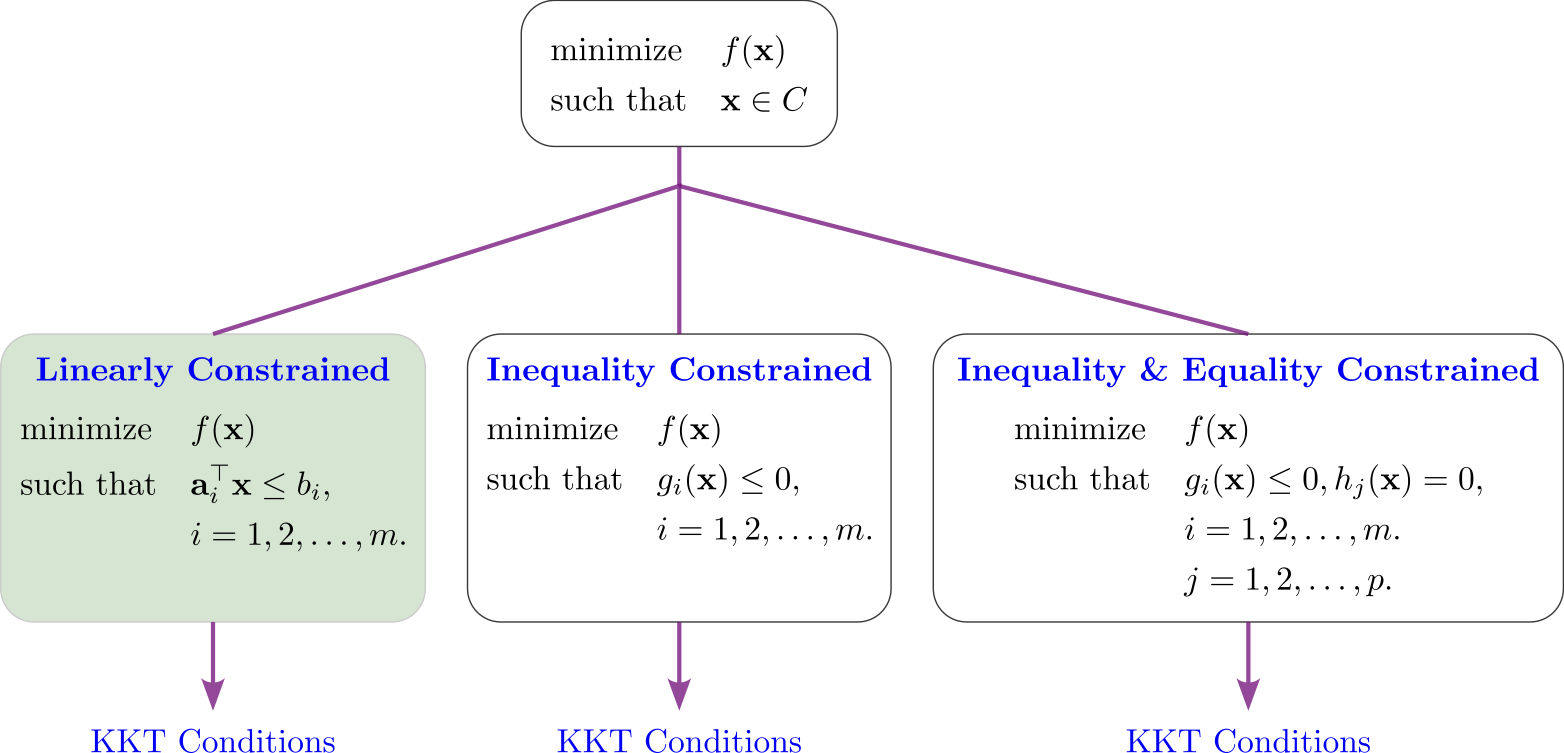
Lecture 10-1: Optimality Conditions for Linearly Constrained Problems#
Download the original slides: CMSE382-Lec10_1.pdf
Warning
This is an AI-generated transcript of the lecture slides and may contain errors or inaccuracies. Please refer to the original course materials for authoritative content.
This Lecture#
Topics:
Optimality conditions: motivation
Separation and alternative theorems
KKT conditions
Lagrangian function
Announcements:
Quiz Weds April 1
Optimality Conditions#
Optimality conditions#
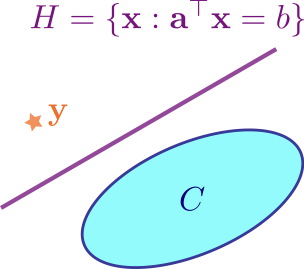
Strict separation theorem#
Theorem (Strict separation theorem)
Let \(C \subseteq \mathbb{R}^n\) be a nonempty closed and convex set, and let \(\mathbf{y} \notin C\). Then there exist \(\mathbf{p} \in \mathbb{R}^n\backslash \{\mathbf{0}\}\) and \(\alpha \in \mathbb{R}\) such that
Meaning: Given \(C\) and \(\mathbf{y}\) as above, it is possible to draw a hyperplane separating \(\mathbf{y}\) and \(C\).
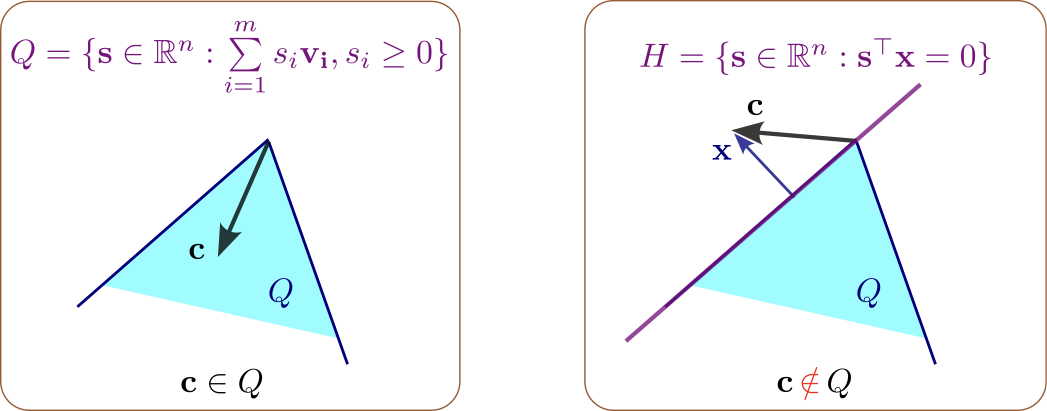
Farkas’ lemma#
Lemma (Farkas’ lemma)
Let \(\mathbf{c} \in \mathbb{R}^n\) and \(A \in \mathbb{R}^{m\times n}\). Then exactly one of the following systems has a solution:
There is an \(\mathbf{x} \in \mathbb{R}^n\) such that \(A \mathbf{x} \le \mathbf{0}\), \(\mathbf{c}^{\top} \mathbf{x} > 0\).
There is a \(\mathbf{y} \in \mathbb{R}^m\) such that \(A^{\top} \mathbf{y} = \mathbf{c}\), \(\mathbf{y} \geq 0\).
Farkas’ lemma v2. Gordan’s alternative theorem#
Lemma (Farkas’ lemma—second formulation)
Let \(\mathbf{c} \in \mathbb{R}^n\) and \(A \in \mathbb{R}^{m\times n}\). Then the following two claims are equivalent.
The implication \(A \mathbf{x} \leq \mathbf{0}\) \(\Rightarrow\) \(\mathbf{c}^{\top} \mathbf{x} \leq 0\) holds true.
There exists \(\mathbf{y} \in \mathbb{R}^M_{+}\) such that \(A^T \mathbf{y} = \mathbf{C}\).
Theorem (Gordon’s alternative theorem)
Let \(A \in \mathbb{R}^{m\times n}\). Then exactly one of the following two systems has a solution:
\(A \mathbf{x} < 0\).
There exists \(\mathbf{p} \neq \mathbf{0}\) that satisfies \(A^{\top} \mathbf{p} = \mathbf{0}\), \(\mathbf{p} \geq \mathbf{0}\)
KKT for linearly constrained problems#
Theorem (Necessary optimality conditions)
Consider the minimization problem
where \(f\) is continuously differentiable over \(\mathbb{R}^n\), \(a_1, a_2, \dots, a_m \in \mathbb{R}^n\), \(b_1, b_2, \dots, b_m \in \mathbb{R}\), and let \(\mathbf{x}^*\) be a local minimum point of (P). Then there exist \(\lambda_1, \lambda_2, \dots, \lambda_m \geq 0\) such that
\(\lambda_1,\ldots,\lambda_m\) are Lagrange multipliers. Non-negative for minimization with inequality constraints.
KKT for convex linearly constrained problems#
Theorem (Necessary and sufficient optimality conditions)
Consider the minimization problem
where \(f\) is a convex continuously differentiable over \(\mathbb{R}^n\), \(a_1, a_2, \dots, a_m \in \mathbb{R}^n\), \(b_1, b_2, \dots, b_m \in \mathbb{R}\), and let \(\mathbf{x}^*\) be a feasible solution of (P). Then \(\mathbf{x}^*\) is an optimal solution of (P) if and only if there exist \(\lambda_1, \lambda_2, \dots, \lambda_m \geq 0\) such that
The condition \(\lambda_i(\mathbf{a}_i^T \mathbf{x}^* - b_i) = 0, \quad i = 1, 2, \dots, m\) is called the complementary slackness condition.
The Lagrangian function#
Definition (The Lagrangian function)
Consider the Nonlinear Programming Problem (NLP)
where \(f\), and all the \(g_i\) and \(h_j\) are continuously differentiable over \(\mathbb{R}^n\).
The associated Lagrangian function is of the form
The necessary KKT condition (stationarity condition) is
The Lagrangian function for linearly constrained optimization#
Recall the minimization problem with linear constraints
The associated Lagrangian function is of the form
The necessary KKT condition \(\nabla f(\mathbf{x}^*) + \sum_{i=1}^{m} \lambda_i \mathbf{a}_i + \sum_{j=1}^{p} \mu_j \mathbf{c}_j = \mathbf{0}\) can be written in terms of the Lagrangian as
Steps for finding the stationary points for a linearly constrained problem#
Write the problem in the standard form
Write down the Lagrangian function
Write down the KKT conditions
Write down the feasibility constraints
If inequality constraints are present, include \(\boldsymbol{\lambda} \geq \mathbf{0}\) as a constraint.
Solve the stationarity and feasibility constraints for the stationary points of the problem.
If the problem is convex, then stationarity implies optimality.