
Worksheet 6-3: Basic Feasible Solutions (with Solutions)#
Download: CMSE382-WS6_3.pdf · Solution PDF
Warning
This is an AI-generated transcript of the worksheet and may contain errors or inaccuracies. Please refer to the original course materials for authoritative content.
Worksheet 6-3: Q1#
Consider the linear system \(A\mathbf{x} = \mathbf{b}\) given by
(a) Which subsets of 2 columns of \(A\) are linearly independent?
Solution
There are \(\binom{5}{2}=10\) possible pairs. The only pair that is NOT linearly independent is \(\{3, 5\}\): column 5 is exactly twice column 3 (\((6,6)^\top = 2(3,3)^\top\)).
All other 9 pairs \(\{1,2\}\), \(\{1,3\}\), \(\{1,4\}\), \(\{1,5\}\), \(\{2,3\}\), \(\{2,4\}\), \(\{2,5\}\), \(\{3,4\}\), \(\{4,5\}\) are linearly independent.
(b) Consider the point \(\mathbf{x} = (0, 2, 0, 1, 0)^\top\). Verify that this is a solution to \(A\mathbf{x} = \mathbf{b}\).
Solution
(c) Is \(\mathbf{x} = (0, 2, 0, 1, 0)^\top\) a basic feasible solution?
Solution
Yes. The nonzero entries are in positions 2 and 4. Columns 2 and 4 of \(A\) are \(\begin{bmatrix}5\\1\end{bmatrix}\) and \(\begin{bmatrix}4\\5\end{bmatrix}\), which are linearly independent (shown above). Since \(\mathbf{x}\) is a solution with the active columns linearly independent, it is a basic feasible solution.
Worksheet 6-3: Q2#
Consider the linear system \(A\mathbf{x} = \mathbf{b}\) given by
(a) Check that the 1st, 4th, and 6th columns of \(A\) are linearly independent.
Solution
Columns 1, 4, 6 of \(A\) are:
These are the standard basis vectors \(\mathbf{e}_1\), \(\mathbf{e}_3\), \(\mathbf{e}_2\) for \(\mathbb{R}^3\), hence linearly independent.
(b) Find the solution to \(A\mathbf{x} = \mathbf{b}\) with nonzero entries only in positions 1, 4, 6. Is it a basic feasible solution?
Solution
Set \(\mathbf{x} = (x_1, 0, 0, x_4, 0, x_6, 0)^\top\). Then:
So \(x_1 = 7\), \(x_6 = 1\), \(x_4 = 2\). The solution is \(\mathbf{x} = (7, 0, 0, 2, 0, 1, 0)^\top\).
All nonzero entries are non-negative and the corresponding columns are linearly independent → basic feasible solution. ✓
(c) Check that the 1st, 3rd, and 4th columns of \(A\) are linearly independent.
Solution
Columns 1, 3, 4 are \(\begin{bmatrix}1\\0\\0\end{bmatrix}\), \(\begin{bmatrix}22\\-5\\0\end{bmatrix}\), \(\begin{bmatrix}0\\0\\1\end{bmatrix}\).
None can be written as a linear combination of the others. In particular, column 3 has a middle entry of \(-5\) while columns 1 and 4 both have middle entry \(0\) — no linear combination of zeros can equal \(-5\). Hence linearly independent.
(d) Find the solution with nonzero entries in positions 1, 3, 4. Is it a basic feasible solution?
Solution
Set \(\mathbf{x} = (x_1, 0, x_3, x_4, 0, 0, 0)^\top\). Then:
This gives \(-5x_3 = 1 \Rightarrow x_3 = -\dfrac{1}{5}\), then \(x_4 = 2\), and \(x_1 = 7 - 22x_3 = 7 + \dfrac{22}{5} = \dfrac{57}{5}\).
The solution is \(\mathbf{x} = \left(\dfrac{57}{5},\ 0,\ -\dfrac{1}{5},\ 2,\ 0,\ 0,\ 0\right)^\top\).
This is NOT a basic feasible solution because \(x_3 = -\frac{1}{5} < 0\) (the solution is not feasible for a standard-form LP requiring \(\mathbf{x} \ge \mathbf{0}\)).
Worksheet 6-3: Q3#
Let \(S\) be a closed, bounded, and convex set. The figure below shows a sampling of points from \(S\) including all extreme points and some interior points.
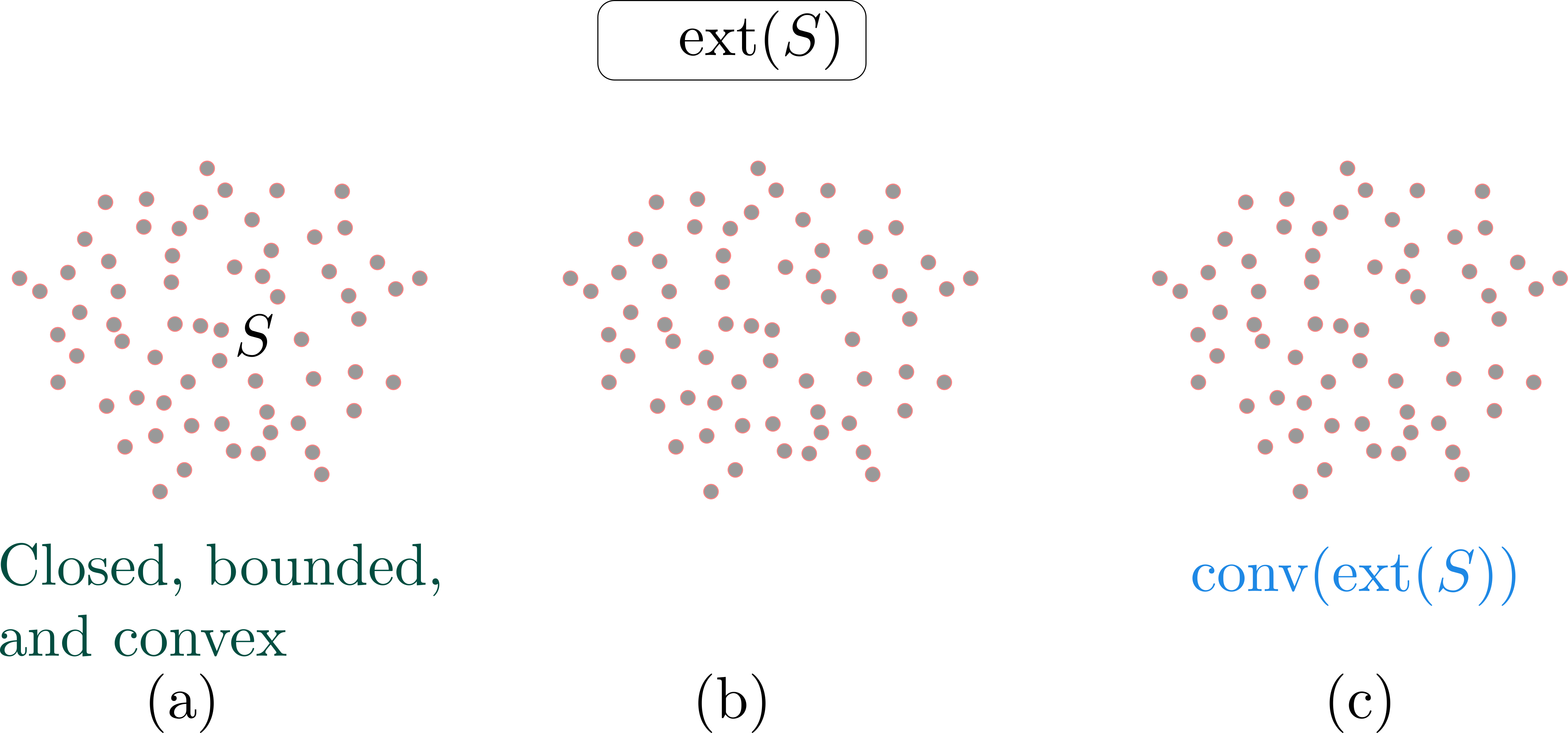
(a) Mark the extreme points \(\text{ext}(S)\).
(b) Highlight \(\text{conv}(\text{ext}(S))\).
(c) What is \(S\)?
Solution
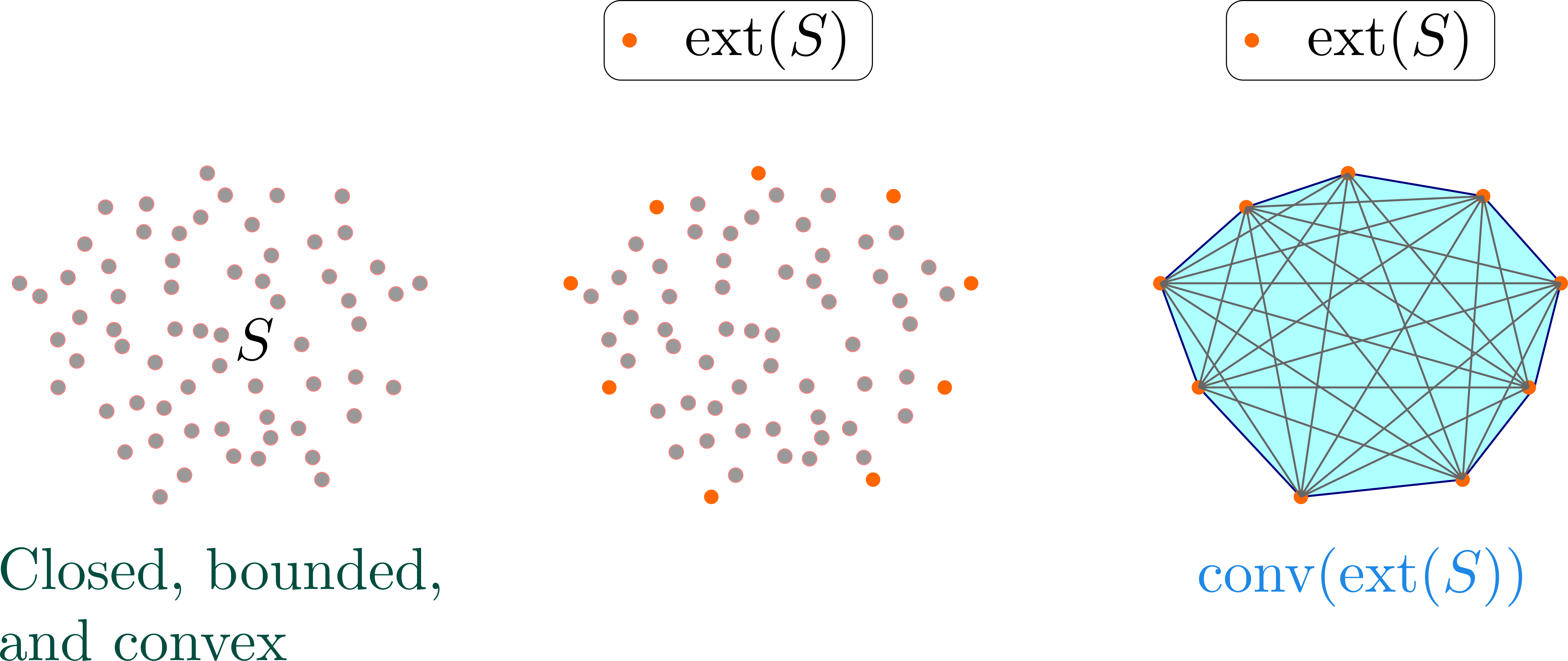
The middle figure marks the extreme points (the boundary points that cannot be expressed as convex combinations of other points in \(S\)).
The right figure shows \(\text{conv}(\text{ext}(S))\) highlighted.
By the Krein–Milman theorem: for a closed, bounded, convex set \(S \subseteq \mathbb{R}^n\):
So \(S\) is exactly the convex hull of its extreme points — the shaded region in the solution figure.