
Worksheet 7-3: Convex Functions (with Solutions)#
Download: CMSE382-WS7_3.pdf, CMSE382-WS7_3-Soln.pdf
Warning
This is an AI-generated transcript of the worksheet and may contain errors or inaccuracies. Please refer to the original course materials for authoritative content.
Worksheet 7-3: Q1#
Consider \(\max{\{\mathbf{x}^{\top} Q \mathbf{x}\mid \|\mathbf{x}\| \leq 1}\}\) where \(\mathbf{x} \in \mathbb{R}^n\) and \(Q \succeq 0\).
(a) Does a maximizer exist? Justify by checking all the conditions of the relevant theorem.
Solution
The theorem says that if the function is continuous and convex defined over a convex compact set, then a maximizer exists. Further, it occurs at the extreme points of the set.
The function \(\mathbf{x}^{\top} Q \mathbf{x}\) is continuous and convex since \(Q \succeq 0\).
The set \(\{\mathbf{x} \mid \|\mathbf{x}\| \leq 1\}\) is convex and compact. It actually doesn’t matter which norm we choose, this will always be true. More on options for norms in the next question.
Since it satisfies the requirements of the theorem, a maximizer exists.
(b) Let \(\mathbf{x} \in \mathbb{R}^2\) (that is, assume \(n=2\) above) and answer the following questions.
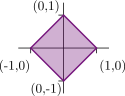
(i) Using \(L_1\)-norm for \(\mathbf{x}\): Sketch the feasible region and point out where a maximizer, if it exists, can be found.
Solution
The region where \(\|\mathbf{x}\|_1 \leq 1\) is the diamond-shaped region shown in the figure. The extreme points of this set are the points where one of the coordinates is \(\pm 1\) and the other is \(0\). These are the points where a maximizer, if it exists, can be found.
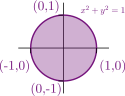
(ii) Using \(L_2\)-norm for \(\mathbf{x}\): Sketch the feasible region and point out where a maximizer, if it exists, can be found.
Solution
The region where \(\|\mathbf{x}\|_2 \leq 1\) is the circular region shown in the figure. The extreme points of this set are the points on the boundary of the circle. These are the points where a maximizer, if it exists, can be found.
Worksheet 7-3: Q2#
Consider the function
What is the effective domain of \(f\), \(\text{dom}(f)\)?
Solution
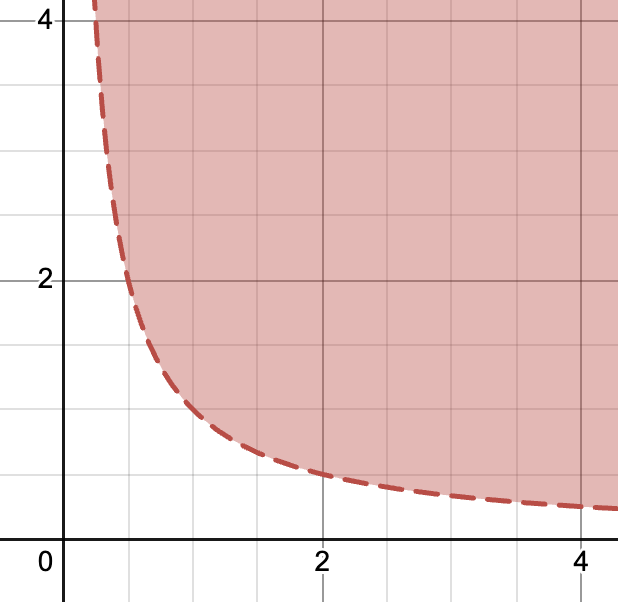
The effective domain of \(f\) is \(\text{dom}(f) = (0,\infty)\) since \(f(x) = \infty\) for \(x=0\) and \(f(x) = 1/x\) for \(x > 0\).
Sketch the epigraph of \(f\).
Solution
Is \(f\) convex? Justify your answer.
Solution
The function \(f\) is convex because the effective domain of \(f\) is \((0,\infty)\) and \(f(x) = 1/x\) is convex on this domain. This can be shown by computing the second derivative of \(f\):
Since the second derivative is positive for all \(x > 0\), \(f\) is convex on its effective domain. Additionally, since \(f(x) = \infty\) for \(x=0\), the function is convex on the entire domain \([0,\infty)\).
Worksheet 7-3: Q3#

For each of the functions shown in the figure, answer the following:
(i) Sketch the sublevel sets at level \(\alpha\).
(ii) Sketch the epigraph.
(iii) Based only on your sketches, is the function convex? Justify your answer.
(iv) Based only on your sketches, is the function quasi-convex?
Solution
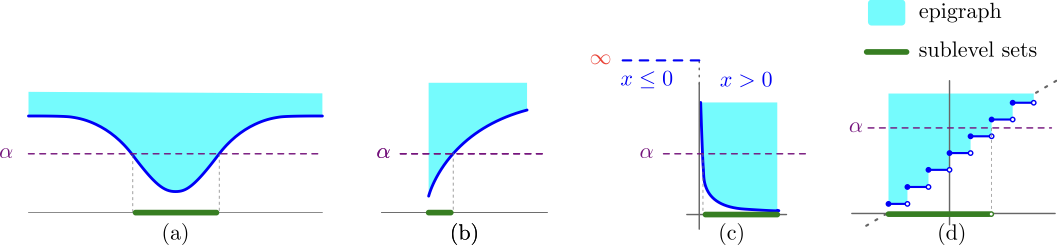
(i) Not convex, but it is quasi-convex.
(ii) Not convex but quasiconvex.
(iii) Convex (which also implies quasiconvex).
(iv) Not convex, but it is quasiconvex.