
Lecture 8-1: Convex Optimization: Part 1#
Download the original slides: CMSE382-Lec8_1.pdf
Warning
This is an AI-generated transcript of the lecture slides and may contain errors or inaccuracies. Please refer to the original course materials for authoritative content.
Convex Optimization Definition#
Convex optimization#
General definition
Convex Optimization: General Definition
where \(C\) is a convex set, and \(f\) is a convex function over \(C\).
 Minimize cost. Control: Production, Demand, Transmission.
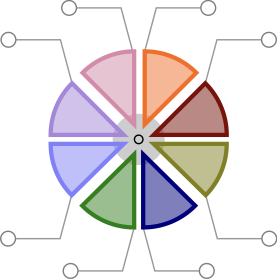 Minimize risk. Control Assets’ allocation.
 Minimize tracking errors. Control joint positions.
Functional definition#
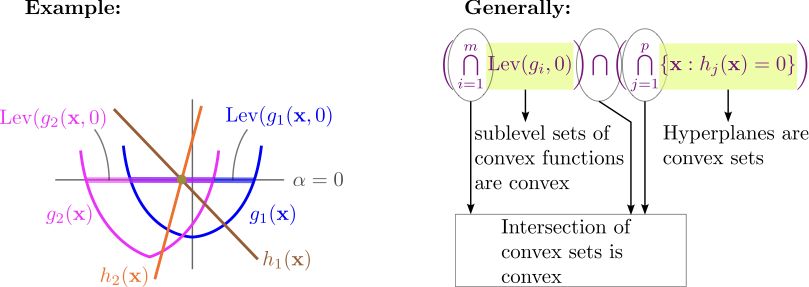
Convex Optimization: Functional Definition
where \(f,g_1,\ldots,g_m:\mathbb{R}^n \to \mathbb{R}\) are convex functions and \(h_1,h_2,\ldots, h_p:\mathbb{R}^n\to \mathbb{R}\) are affine functions.
Reasons we like convex optimization: Local minima are global minima#
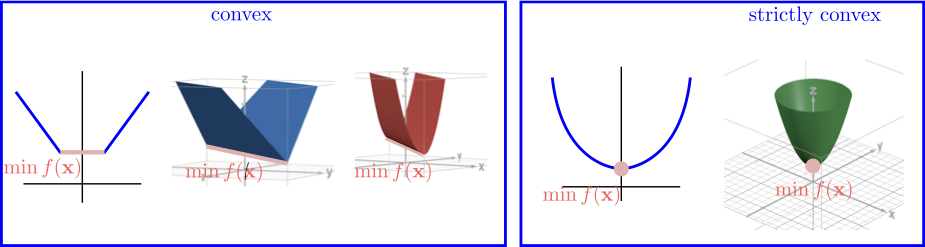
Theorem (local minimum is global minimum in convex optimization)
Let \(f: C \to \mathbb{R}\) be defined on the convex set \(C\). Let \(x^* \in C\) be a local minimum of \(f\) over \(C\).
If \(f\) is convex, then \(\mathbf{x}^*\) is a global minimum of \(f\) over \(C\).
If \(f\) is strictly convex, then \(\mathbf{x}^*\) is a strict global minimum of \(f\) over \(C\).
Reasons we like convex optimization: Convexity of the optimal set#
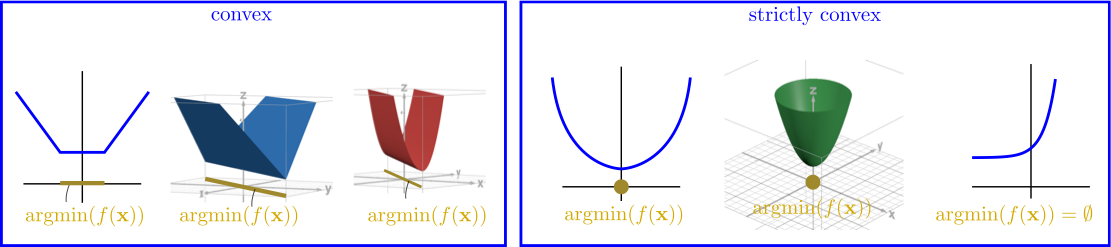
Theorem (Convexity of the optimal set in convex optimization)
Let \(f: C \to \mathbb{R}\) be a convex function defined over the convex set \(C \subseteq \mathbb{R}^n\). Let \(X^*\) be the set of optimal solutions of the problem given by the equation
Then:
If \(f\) is convex, then \(X^*\) is convex.
If \(f\) is strictly convex, then \(X^*\) cotains at most one optimal solution.
Convex Optimization Example: Linear Programming#
Motivation#
Linear Optimization (Linear Programming)
Find:
\([\) Production(P), Demand(D), Transmission (T) \(]\)
That maximizes efficiency \(c_1 \times P + c_2 \times D + c_3 \times T\)
Subject to constraints:
production = demand
transmission \(\leq\) grid capacity
energy stored \(\leq\) capacity
\(\vdots\)
Linear optimization
(Standard form)
Recall: Feasible region#
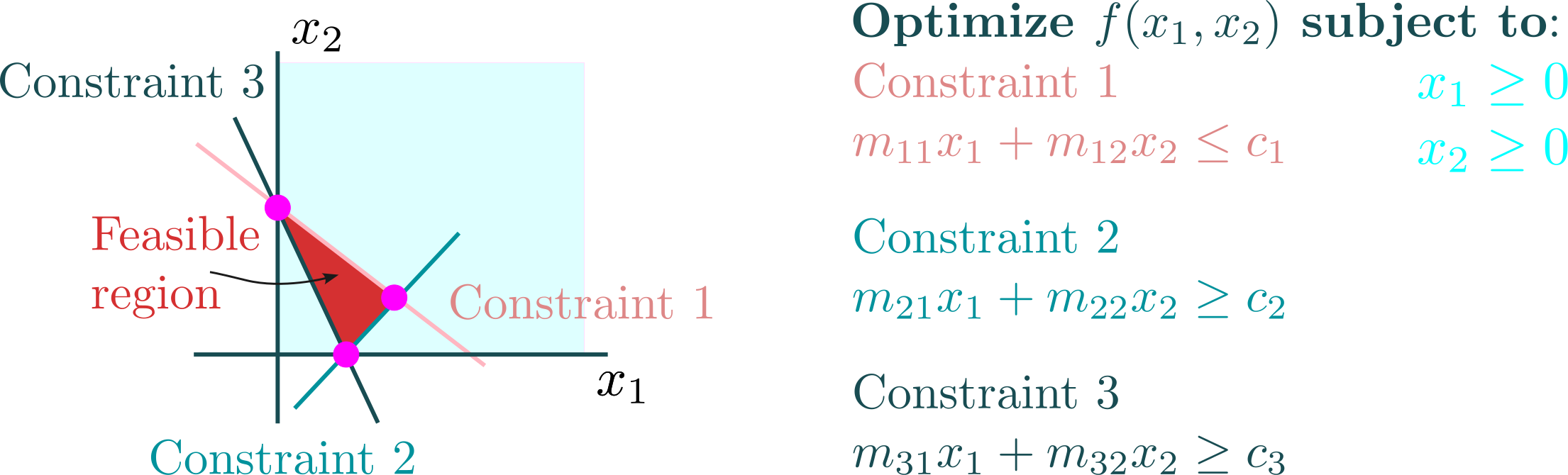
Definition
A Feasible region of an optimization problem is the set of all possible points that satisfy the problem’s constraints.
It represents all the possible candidates for the optimization solution.