
Worksheet 1-1#
Download the original worksheet: CMSE382-WS-1_1.pdf
Warning
This is an AI-generated transcript of the worksheet and may contain errors or inaccuracies. Please refer to the original course materials for authoritative content.
Worksheet 1-1: Q1#
For the \(L_p\) norm \(\|x\|_p = \sqrt[p]{\sum_{i=1}^{n} |x_i|^p}\), we will check that the restriction \(p \geq 1\) is necessary because for \(0 \leq p < 1\) the function \(\|\cdot\|_p\) is not a norm. Let’s investigate this using the case \(p = \frac{1}{2}\), where
Write \(\|x\|_{\frac{1}{2}}\) for each of the following vectors \(x\):
(a) \(e_1\) (b) \(\begin{bmatrix} 1 \\ 1 \\ 0 \\ 1 \end{bmatrix}\) (c) \(\begin{bmatrix} 1 \\ 1 \\ 1 \\ 1 \end{bmatrix}\) (d) \(\begin{bmatrix} 1 \\ 1 \end{bmatrix}\)
Let’s see which of the norm properties (nonnegativity, positive homogeneity, triangle inequality) is violated for \(p = \frac{1}{2}\).
(a) Show that the nonnegativity property is satisfied for an arbitrary \(x\).
(b) Show that the homogeneity property is satisfied for an arbitrary \(\lambda\) and \(x\).
(c) Show the triangle inequality is violated. Specifically, consider the two standard basis vectors \(e_1\) and \(e_2\) and check whether \(\|e_1 + e_2\|_{0.5} \leq \|e_1\|_{0.5} + \|e_2\|_{0.5}\).
Worksheet 1-1: Q2#
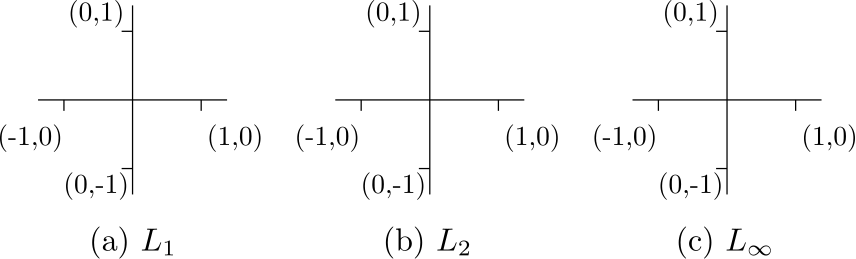
Let’s look at a visual representation of planar vectors whose \(L_p\) norm is equal to \(1\).
Start with the \(L_1\) norm. Four vectors that satisfy \(\|x\| = 1\) include \((-1,0)\), \((0,-1)\), \((1,0)\), and \((0,1)\). For each of the following, find the missing \(x\) or \(y\) entry that makes its \(L_1\) norm equal to \(1\).
(a) \((0.1, y)\) (b) \((x, 0.5)\) (c) \((0.75, y)\)
Draw a geometric shape that shows all possible endpoints of vectors satisfying \(\|x\|_1 = 1\).
Now work with the \(L_2\) norm. Write the \(L_2\) norm equation for two arbitrary planar vectors and set it equal to \(1\). Does the resulting equation remind you of a geometric shape? Draw it in part (b) of the figure below.
Finally, write the equation that describes \(\|x\|_{\infty} = 1\). What is the requirement on the \(x\), \(y\) components? Draw the geometric shape formed by all vectors satisfying \(\|x\|_{\infty} = 1\).
Worksheet 1-1: Q3#
Recall the Cauchy-Schwarz inequality: for any \(\mathbf{x}, \mathbf{y} \in \mathbb{R}^n\),
The left-hand side represents the dot product. Recall \(x \cdot y = \|x\| \|y\| \cos\theta\), where \(\theta\) is the angle between the two vectors. Based on this, when will the two sides of the inequality be equal?
Sketch two vectors in \(\mathbb{R}^2\) for which the equality holds.