
Worksheet 6-3: Basic Feasible Solutions#
Download: CMSE382-WS6_3.pdf
Warning
This is an AI-generated transcript of the worksheet and may contain errors or inaccuracies. Please refer to the original course materials for authoritative content.
Worksheet 6-3: Q1#
Consider the linear system \(A\mathbf{x} = \mathbf{b}\) given by
(a) Which subsets of 2 columns of \(A\) are linearly independent? (Hint: there are 10 possible pairs; identify the one that is not linearly independent.)
(b) Consider the point \(\mathbf{x} = (0, 2, 0, 1, 0)^\top\). Verify that this is a solution to \(A\mathbf{x} = \mathbf{b}\).
(c) Is \(\mathbf{x} = (0, 2, 0, 1, 0)^\top\) a basic feasible solution? Why or why not?
Worksheet 6-3: Q2#
Consider the linear system \(A\mathbf{x} = \mathbf{b}\) given by
(a) Check that the 1st, 4th, and 6th columns of \(A\) are linearly independent.
(b) Find the solution to \(A\mathbf{x} = \mathbf{b}\) with nonzero entries only in positions 1, 4, and 6. Is it a basic feasible solution?
(c) Check that the 1st, 3rd, and 4th columns of \(A\) are linearly independent.
(d) Find the solution to \(A\mathbf{x} = \mathbf{b}\) with nonzero entries only in positions 1, 3, and 4. Is it a basic feasible solution? Why or why not?
Worksheet 6-3: Q3#
Let \(S\) be a closed, bounded, and convex set. The figure below (Fig. a) shows a sampling of points from \(S\) that includes all the extreme points and some interior points.
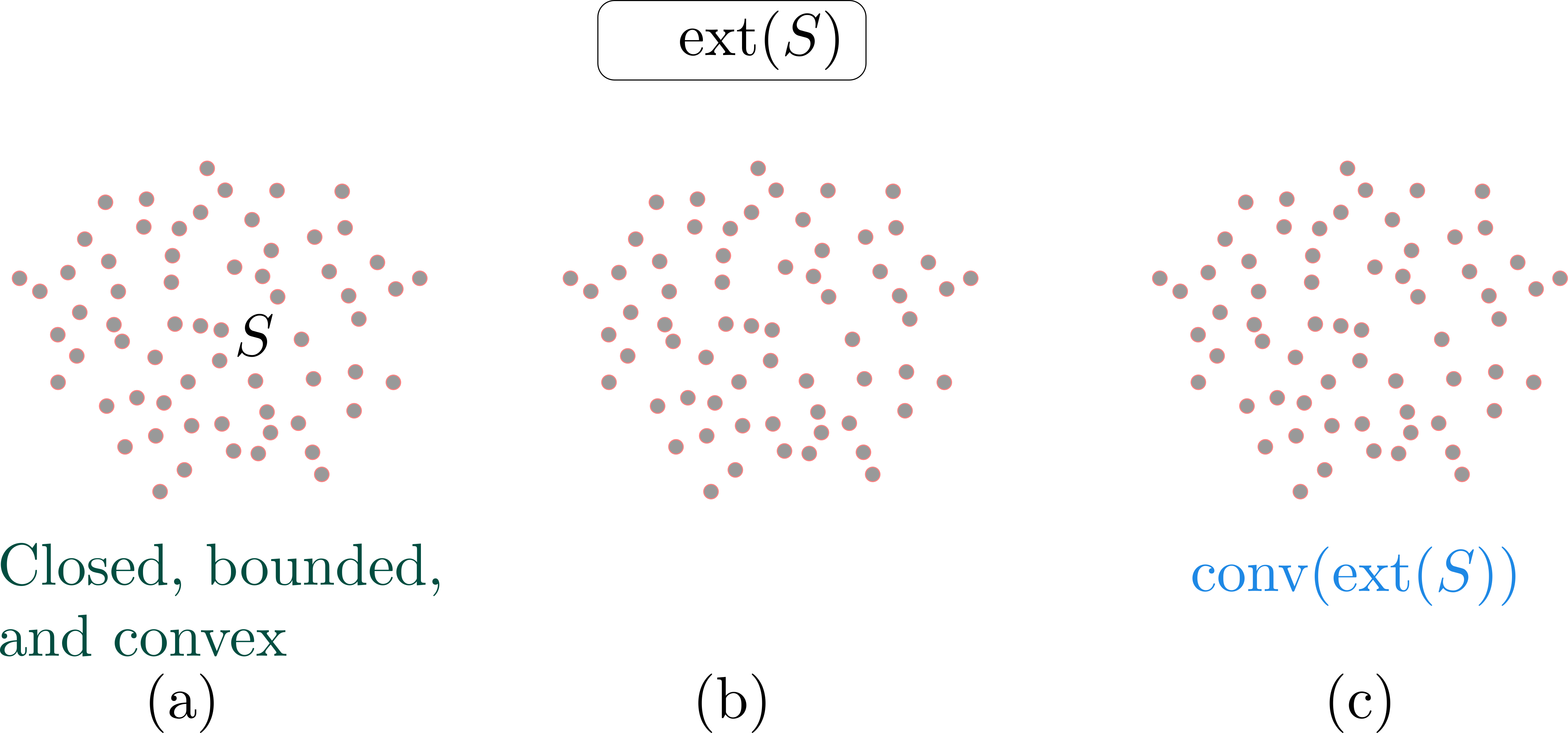
(a) Mark the extreme points \(\text{ext}(S)\) on Fig. b.
(b) Highlight the region \(\text{conv}(\text{ext}(S))\) on Fig. c.
(c) What is your best guess for the full set \(S\)? Explain your answer.