
Worksheet 6-2: Convex Cones (with Solutions)#
Download: CMSE382-WS6_2.pdf · Solution PDF
Warning
This is an AI-generated transcript of the worksheet and may contain errors or inaccuracies. Please refer to the original course materials for authoritative content.
Worksheet 6-2: Q1#
For each of the following sets, determine whether it is a cone, a convex cone, both, or neither.
Recall: A set \(C\) is a cone if \(\mathbf{x} \in C \Rightarrow t\mathbf{x} \in C\) for all \(t \ge 0\). It is a convex cone if it is both a cone and convex.
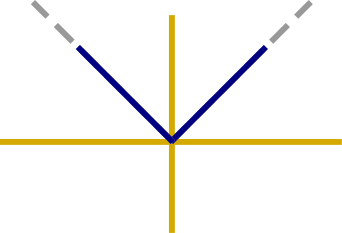
(a) \(S = \{(x, |x|) \mid x \in \mathbb{R}\}\)
Solution
Cone, but NOT a convex cone.
Cone: If \((x, |x|) \in S\) and \(t \ge 0\), then \(t(x, |x|) = (tx, t|x|) = (tx, |tx|) \in S\). ✓
Not convex: Take \((1, 1)\) and \((-1, 1)\) in \(S\). Their midpoint is \((0, 1) \notin S\) since it would require \(|0| = 0 \ne 1\).
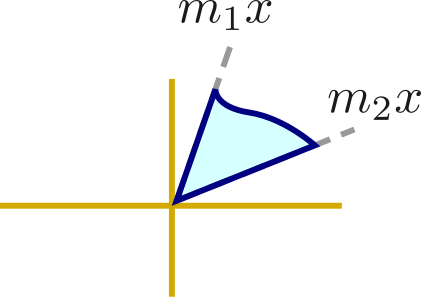
(b) \(S = \{(x,y) \in \mathbb{R}^2_+ \mid y \le m_1 x \text{ and } y \ge m_2 x\}\)
Solution
Convex cone.
Cone: The constraints \(y \le m_1 x\), \(y \ge m_2 x\), \(x \ge 0\), \(y \ge 0\) are all homogeneous, so scaling by \(t \ge 0\) preserves membership. ✓
Convex: The set is the intersection of four half-spaces (all defined by linear inequalities through the origin), hence convex. ✓
(c) \(S = \{(x,y) \mid x \le 0, y \ge 0\} \cup \{(x,y) \mid x \ge 0, y \le 0\}\)

Solution
Cone, but NOT a convex cone.
Cone: Both quadrants (\(Q_2\) and \(Q_4\)) are cones, and their union is also a cone (scaling by \(t \ge 0\) maps each quadrant to itself). ✓
Not convex: Take \((-1, 1) \in Q_2\) and \((1, -1) \in Q_4\). Their midpoint is \((0, 0) \in S\), but e.g. \((-1,1)\) and \((1,-1)\) combined: try \((0.5)(-1,1)+(0.5)(1,-1) = (0,0) \in S\). Instead, take \((-1,0)\) (in \(Q_2 \cup Q_3\) boundary) and \((0,-1)\) (in \(Q_4 \cup Q_3\) boundary); midpoint \((-0.5,-0.5)\) is in \(Q_3 \notin S\). Hence not convex.
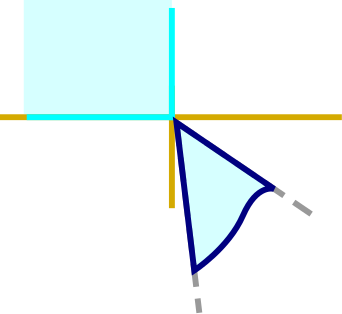
(d) The region shown below:
Solution
NOT a cone.
The region shown is a bounded set (does not extend to the origin in all directions, or is otherwise bounded), so it fails the cone property: scaling a point in \(S\) by large \(t\) takes it outside \(S\).
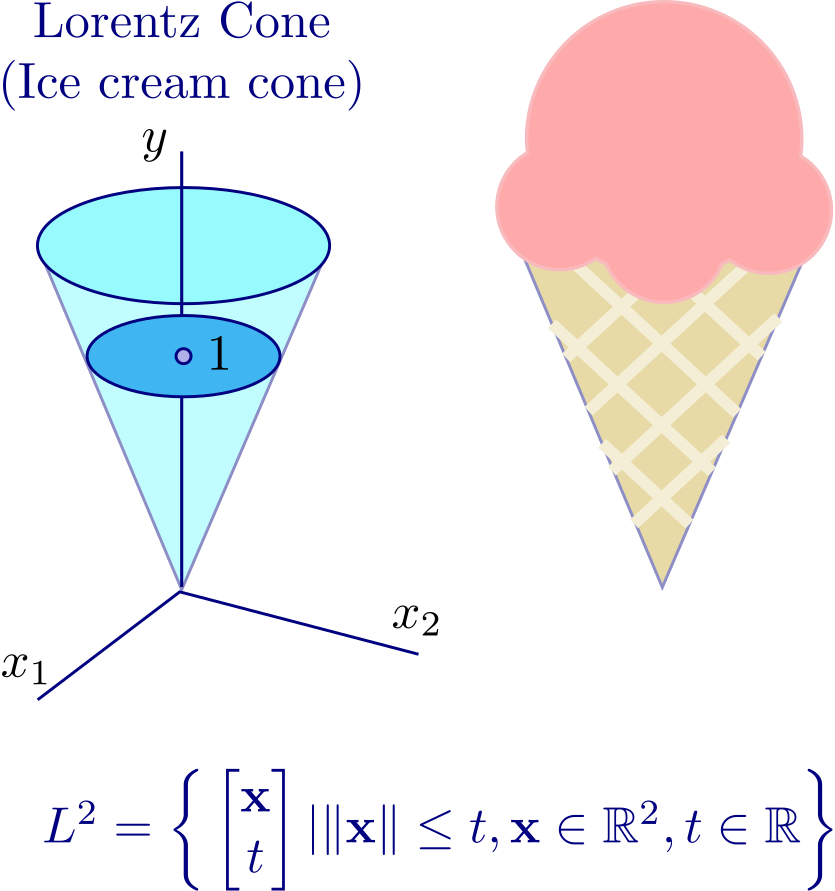
(e) The Lorentz (second-order) cone: \(S = \{(x_1, x_2, y) \in \mathbb{R}^3 \mid \|(x_1, x_2)\|_2 \le y\}\)
Solution
Convex cone.
Cone: If \(\|(x_1,x_2)\|_2 \le y\) and \(t \ge 0\), then \(\|t(x_1,x_2)\|_2 = t\|(x_1,x_2)\|_2 \le ty\). ✓
Convex: For \((x_1,x_2,y)\) and \((x_1',x_2',y')\) in \(S\) and \(\lambda \in [0,1]\): $\(\|(1-\lambda)(x_1,x_2)+\lambda(x_1',x_2')\|_2 \le (1-\lambda)\|(x_1,x_2)\|_2 + \lambda\|(x_1',x_2')\|_2 \le (1-\lambda)y + \lambda y'\)$ by the triangle inequality. ✓
(f) \(S = \{(x,y) \mid y \ge |x|\}\)
Solution
Convex cone.
Cone: If \(y \ge |x|\) and \(t \ge 0\), then \(ty \ge t|x| = |tx|\). ✓
Convex: This is the intersection of two half-planes \(\{y \ge x\}\) and \(\{y \ge -x\}\), both convex. Their intersection is convex. ✓
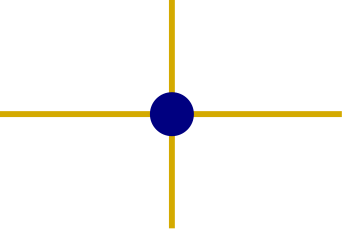
(g) \(S = \{\mathbf{0}\} \subset \mathbb{R}^n\)
Solution
Convex cone.
Cone: \(t \cdot \mathbf{0} = \mathbf{0} \in S\) for all \(t \ge 0\). ✓
Convex: A single point is always convex. ✓
The zero set is the trivial convex cone.