
Worksheet 11-2: The KKT Conditions#
Download: CMSE382-WS11_2.pdf
Warning
This is an AI-generated transcript of the worksheet and may contain errors or inaccuracies. Please refer to the original course materials for authoritative content.
Worksheet 11-2: Q1#
Consider the problem
What are the function(s) \(g_i\) for this problem in Slater’s condition?
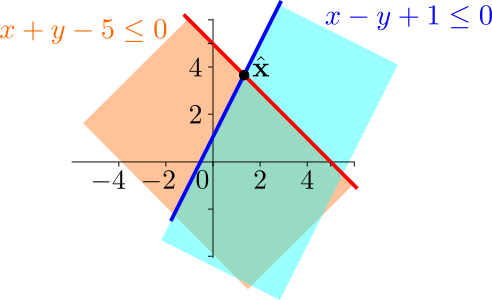
For each of the following, does the shown \(\hat{\mathbf{x}}\) satisfy Slater’s condition?
Worksheet 11-2: Q2#
Consider the same problem
What are the function(s) \(g_i\), \(h_j\), and \(s_k\) in the generalized Slater’s condition for this problem?
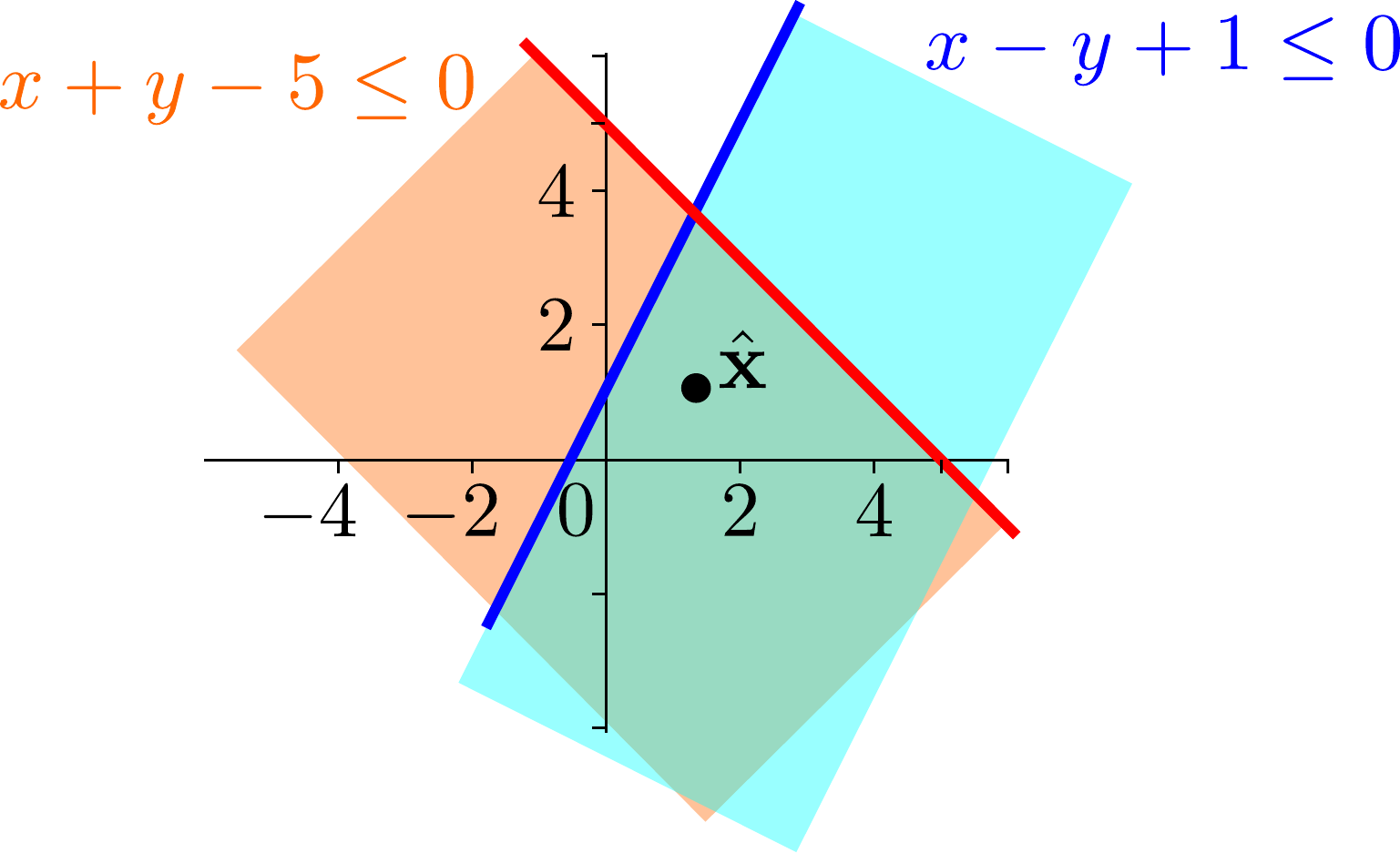
For each of the following, does the shown \(\hat{\mathbf{x}}\) satisfy the generalized Slater’s condition?
Worksheet 11-2: Q3#
Consider the problem
What are the function(s) \(g_i\), \(h_j\), and \(s_k\) in the generalized Slater’s condition for this problem?
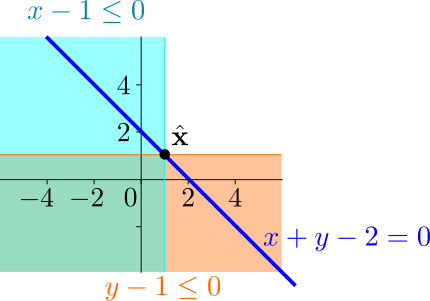
For the following, does the shown \(\hat{\mathbf{x}}\) satisfy the generalized Slater conditions?
Worksheet 11-2: Q4#
For each of the following problems, draft a solution strategy for obtaining the optimal solution, if it exists. That is, describe the steps you would take to solve the problem without actually solving, with a particular focus on whether the KKT conditions are necessary and/or sufficient for optimality, and if so, how you would use them to find the optimal solution.
\(\min{x_1^2-x_2}\) s.t. \(x_2=0\).
\(\min{x_1^2-x_2}\) s.t. \(x_2^2 \leq 0\).
Worksheet 11-2: Q5#
Consider the problem
Does this problem satisfy Slater’s condition?
Are the KKT conditions necessary for optimality for this problem? Are the KKT conditions sufficient for optimality for this problem?
Time permitting, solve the problem using the KKT conditions. Hint: Check the case where \(\lambda_1 > 0\) and \(\lambda_2 = 0\) first, where \(\lambda_1\) is associated to the \(2x_1+x_2=1\) constraint and \(\lambda_2\) is associated to the \(x_1^2=1\) constraint.