Lecture 6-1: Convex Sets: Part 1#
Download the original slides: CMSE382-Lec6_1.pdf
Warning
This is an AI-generated transcript of the lecture slides and may contain errors or inaccuracies. Please refer to the original course materials for authoritative content.
Convex Set Definitions#
Topics Covered#
Topics:
Definition of convex sets
Algebraic operations on Convex Sets
Convex Hull
Convex Sets#
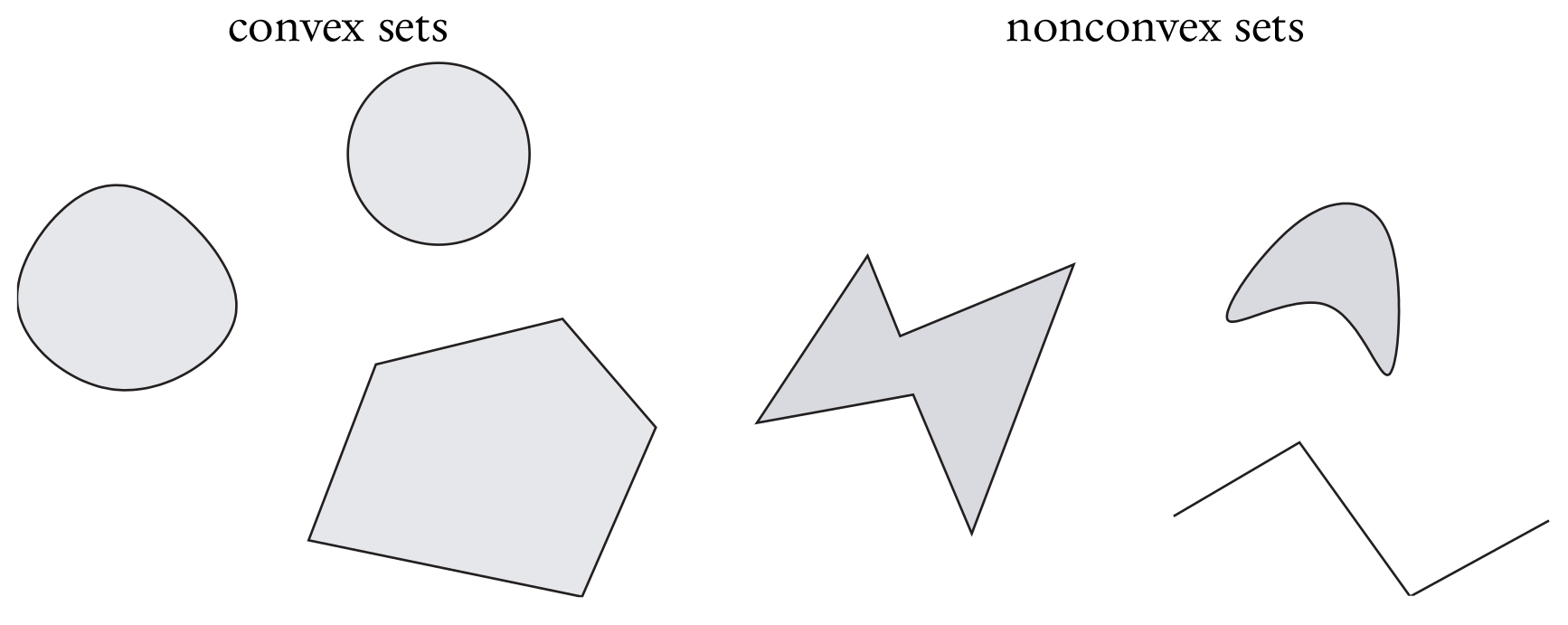
A set \(C \subseteq \mathbb{R}^n\) is convex if for any \(\textbf{x}, \textbf{y} \in C\), the line segment \([\textbf{x}, \textbf{y}]\) is also in \(C\).
Examples: Lines#
A line in \(\mathbb{R}^n\) is a set of points in the form
where \(\mathbf{z},\mathbf{d}\in\mathbb{R}^n\) and \(\mathbf{d}\neq 0\). The point \(\mathbf{z}\) is on the line, and the line is parallel to the direction \(\mathbf{d}\).
Closed and open line segments between two different points \(\mathbf{x}, \mathbf{y}\in\mathbb{R}^n\):
\([\mathbf{x},\mathbf{y}]:=\{\lambda\mathbf{x}+(1-\lambda)\mathbf{y}:0\leq\lambda\leq 1\}\)
\((\mathbf{x},\mathbf{y}):=\{\lambda\mathbf{x}+(1-\lambda)\mathbf{y}:0<\lambda< 1\}\)
\([\mathbf{x},\mathbf{y}):=\{\lambda\mathbf{x}+(1-\lambda)\mathbf{y}:0<\lambda\leq 1\}\)
More Examples of Convex Sets#
empty set \(\emptyset\) and the whole space \(\mathbb{R}^n\).
hyperplane: \(\{\mathbf{x}\in\mathbb{R}^n:\mathbf{a}^\top\mathbf{x}=b\}\) for \(\mathbf{0}\neq\mathbf{a}\in\mathbb{R}^n\) and \(b\in\mathbb{R}\).
closed and open half-spaces: Given \(\mathbf{0}\neq\mathbf{a}\in\mathbb{R}^n\) and \(b\in\mathbb{R}\)
\(\{\mathbf{x}\in\mathbb{R}^n:\mathbf{a}^\top\mathbf{x}\leq b\}\)
\(\{\mathbf{x}\in\mathbb{R}^n:\mathbf{a}^\top\mathbf{x}<b\}\)
balls: Given \(\mathbf{c}\in\mathbb{R}^n\) and \(r>0\)
\(B(\mathbf{c}, r) := \{\mathbf{x}\in\mathbb{R}^n:\|\mathbf{x}-\mathbf{c}\|<r\}\)
\(B[\mathbf{c}, r] := \{\mathbf{x}\in\mathbb{R}^n:\|\mathbf{x}-\mathbf{c}\|\leq r\}\)
ellipsoid: \(\{\mathbf{x}\in\mathbb{R}^n:(\mathbf{x}-\mathbf{b})^\top\mathbf{Q}(\mathbf{x}-\mathbf{b})\leq c\}\) with \(\mathbf{Q}\in\mathbb{R}^{n\times n}\) being positive semidefinite, \(\mathbf{b}\in\mathbb{R}^n\), and \(c>0\).
Algebraic Operations on Convex Sets#
Intersection of Convex Sets#
Property: The intersection of any convex sets is convex.
Example: Convex polytopes \(\{\mathbf{x}\in\mathbb{R}^n:\mathbf{A}_i{x}\leq\mathbf{b}_i\}\) with \(\mathbf{A}\in\mathbb{R}^{m\times n}\) and \(\mathbf{b}\in\mathbb{R}^m\).
Linear Combinations#
Property: The linear combination of a finite number of convex sets is convex.
Let \(C_1, C_2, \ldots, C_k \subseteq \mathbb{R}^n\) be convex sets
Let \(\mu_1, \mu_2, \ldots, \mu_k \in \mathbb{R}\). Then the set
is convex.
Products#
Property: The Cartesian product of a finite number of convex sets is convex.
Let \(C_i \subseteq \mathbb{R}^{k_i}\) be a convex set for any \(i = 1, 2, \ldots, m\).
Then
is convex.
Linear Transforms#
Property: The image of a convex set under a linear transformation is convex.
Let \(M\subseteq \mathbb{R}^n\) be a convex set and let \(\textbf{A} \in \mathbb{R}^{m \times n}\). Then the set
is convex.
Property: If a convex set is a linear transform of another set, then that set is convex.
Let \(D \subseteq \mathbb{R}^m\) be a convex set, and let \(\textbf{A} \in \mathbb{R}^{m \times n}\). Then the set
is convex.
Nonexample#
Unions of convex sets are not necessarily convex.
Topological Properties of Convex Sets#
Recall: Interior Points#
Definition: Given a set \(U \subset \mathbb{R}^n\), a point \(\mathbf{c}\in U\) is an interior point of \(U\) if there exists \(r >0\) such that \(B(\mathbf{c}, r) \subset U\). The set of all interior points is called the interior and defined as
Examples:
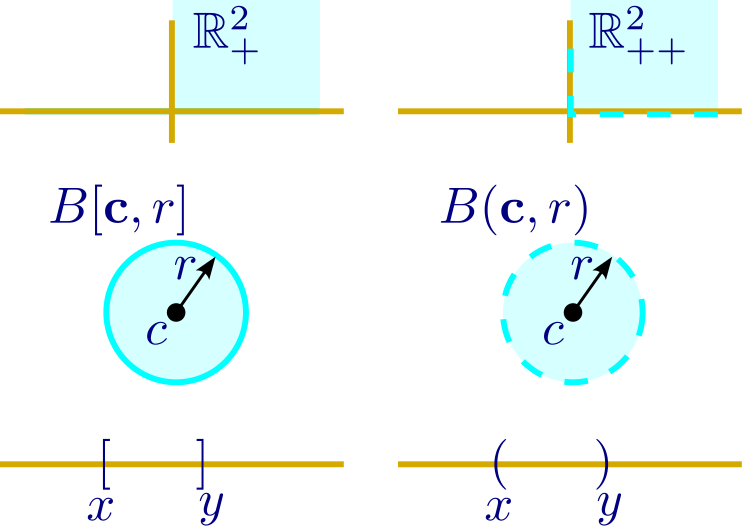
\(\text{int}(\mathbb{R}_+^n)=\mathbb{R}_{++}^n\)
\(\text{int}(B[\mathbf{c},r]) = B(\mathbf{c},r)\)
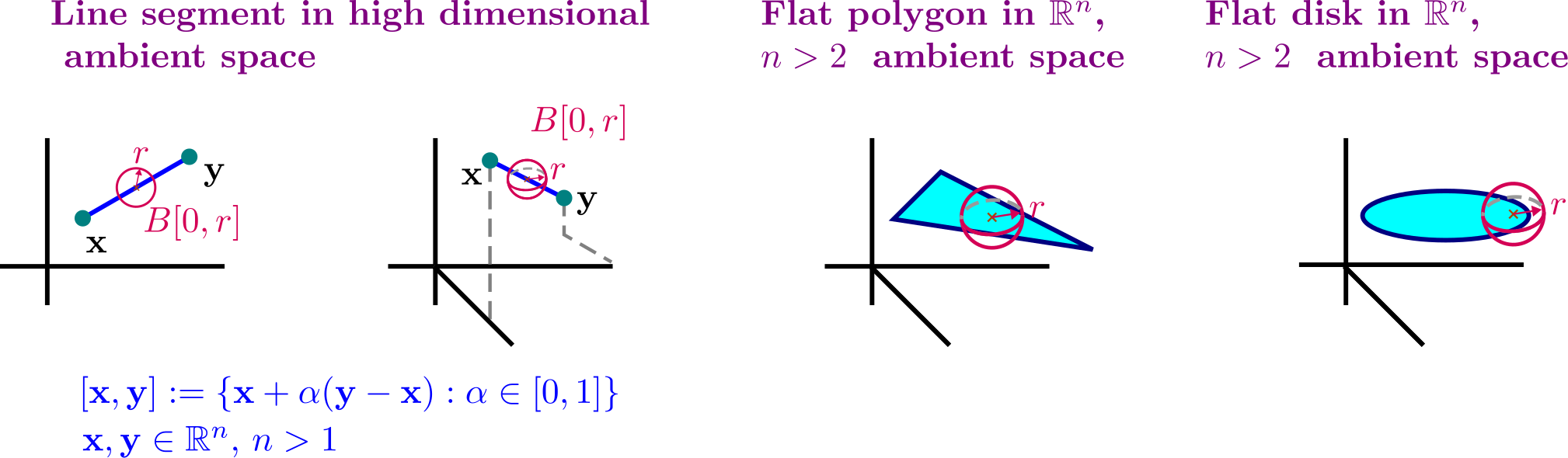
\(\text{int}([\mathbf{x},\mathbf{y}])=(\mathbf{x},\mathbf{y})\) if \(\mathbf{x}\neq\mathbf{y}\)
\(\text{int}([\mathbf{x},\mathbf{x}]) = \emptyset\)
Examples of Convex Sets with Empty Interior#
Topological Properties of Convex Sets#
Theorem: The closure of a convex set is convex.
Theorem: The interior of a convex set is convex.
Theorem: Let \(C\) be a convex set with a nonempty interior. Then:
\(\text{cl}(\text{int}(C)) = \text{cl}(C)\)
\(\text{int}(\text{cl}(C)) = \text{int}(C)\)
Theorem: The convex hull of a finite set is closed.
Convex Hulls#
Convex Combinations#
Definition: Given \(k\) points \(\mathbf{x}_1,\mathbf{x}_2,\dots,\mathbf{x}_k \in\mathbb{R}^n\), a convex combination of these \(k\) points is a point of the form
where \(\lambda_1,\lambda_2,\dots,\lambda_k\) are nonnegative numbers satisfying \(\lambda_1 +\lambda_2 +\dots +\lambda_k = 1\). We denote
A convex set is defined by the property that any convex combination of two points from the set is also in the set.
Convex Combinations Theorem#
Theorem: Let \(C\subset \mathbb{R}^n\) be a convex set and \(\mathbf{x}_1,\mathbf{x}_2,\cdots,\mathbf{x}_m\in C\). Then for any \(\lambda\in\Delta_m\), we have \(\sum_{i=1}^m\lambda_i\mathbf{x}_i\in C\).
A convex combination of any number of points from a convex set is in the set.
Convex Hulls#
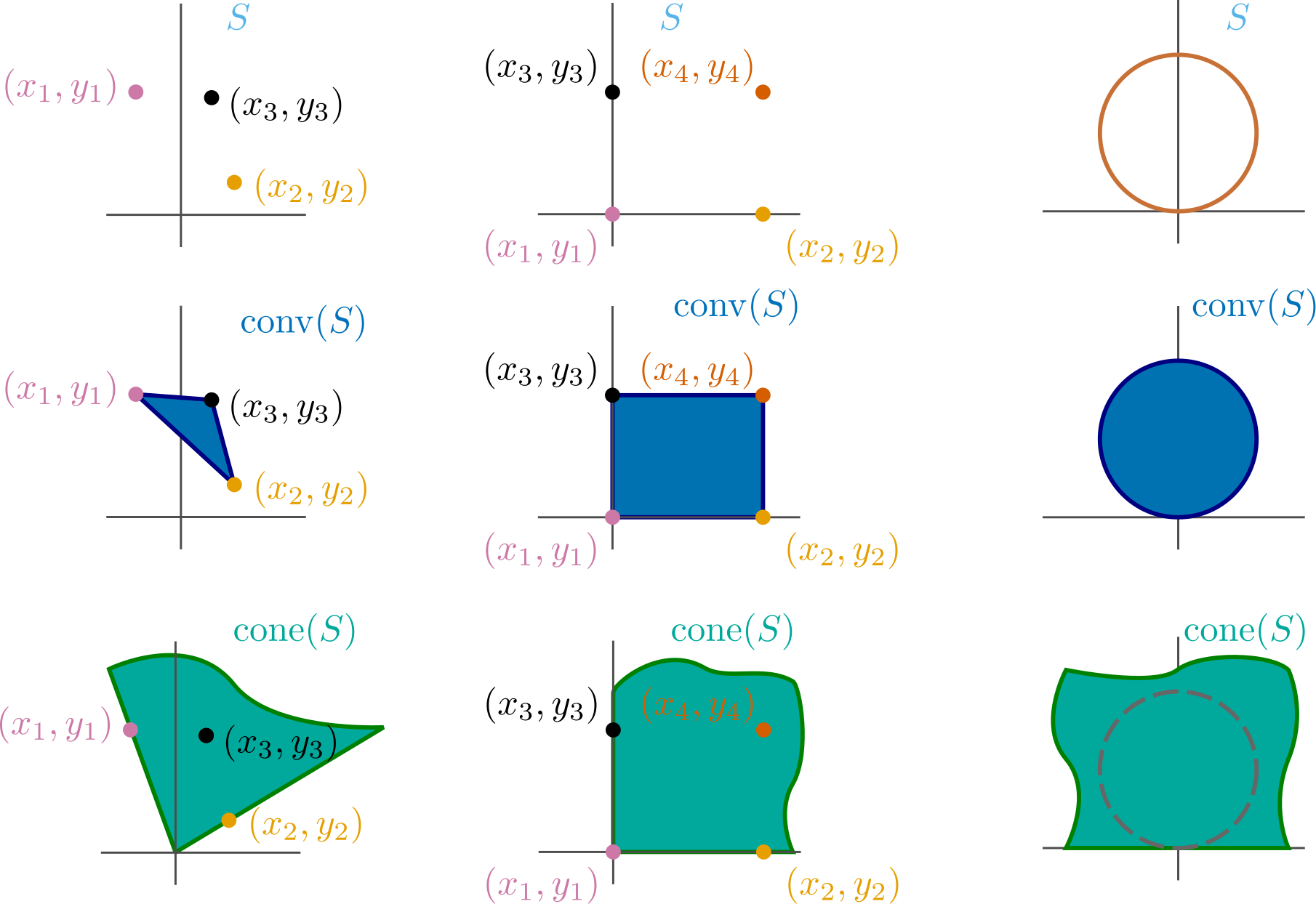
Let \(S\subset \mathbb{R}^n\). The convex hull of \(S\) is defined as
Lemma: Let \(S \subseteq \mathbb{R}^n\). If \(S \subseteq T\) for some convex set \(T\), then \(\text{conv}(S) \subseteq T\).
The convex hull of \(S\) is the smallest convex set containing \(S\).
Theorem: If \(x\in \mathrm{Conv}(S)\subset \mathbb{R}^{d}\), then \(x\) is the convex sum of at most \(d+1\) points of \(S\).
Example: Convex Hull#
Let \(S\) contain four points:
Given \(\mathbf{x}=\begin{bmatrix}1.5\\1.4\end{bmatrix}\), we can find three points from the four points such that \(\mathbf{x}\) is a linear combination of these three points.
\(\mathbf{x}\) is a linear combination of \(\mathbf{x}_1\), \(\mathbf{x}_2\), and \(\mathbf{x}_3\): \(\mathbf{x}=0.1\mathbf{x}_1+0.4\mathbf{x}_2+0.5\mathbf{x}_3\)
Convex Hull Examples#