
Lecture 6-2: Convex Sets: Part 2#
Download the original slides: CMSE382-Lec6_2.pdf
Warning
This is an AI-generated transcript of the lecture slides and may contain errors or inaccuracies. Please refer to the original course materials for authoritative content.
Cones#
Topics Covered#
Topics:
Convex cones
Conic combinations
Review: Last Time#
Definition: A set \(C \subseteq \mathbb{R}^n\) is convex if for any \(\textbf{x}, \textbf{y} \in C\), the line segment \([\textbf{x}, \textbf{y}]\) is also in \(C\).
Definition: The convex hull of a set \(S \subseteq \mathbb{R}^n\) is the smallest convex set containing \(S\).
Definition: A convex combination of points \(\textbf{x}_1, \textbf{x}_2, \ldots, \textbf{x}_k\) is a point of the form \(\lambda_1\textbf{x}_1 + \lambda_2\textbf{x}_2 + \ldots + \lambda_k\textbf{x}_k\), where \(\lambda_i \geq 0\) and \(\sum_{i=1}^k \lambda_i = 1\).
Cones#
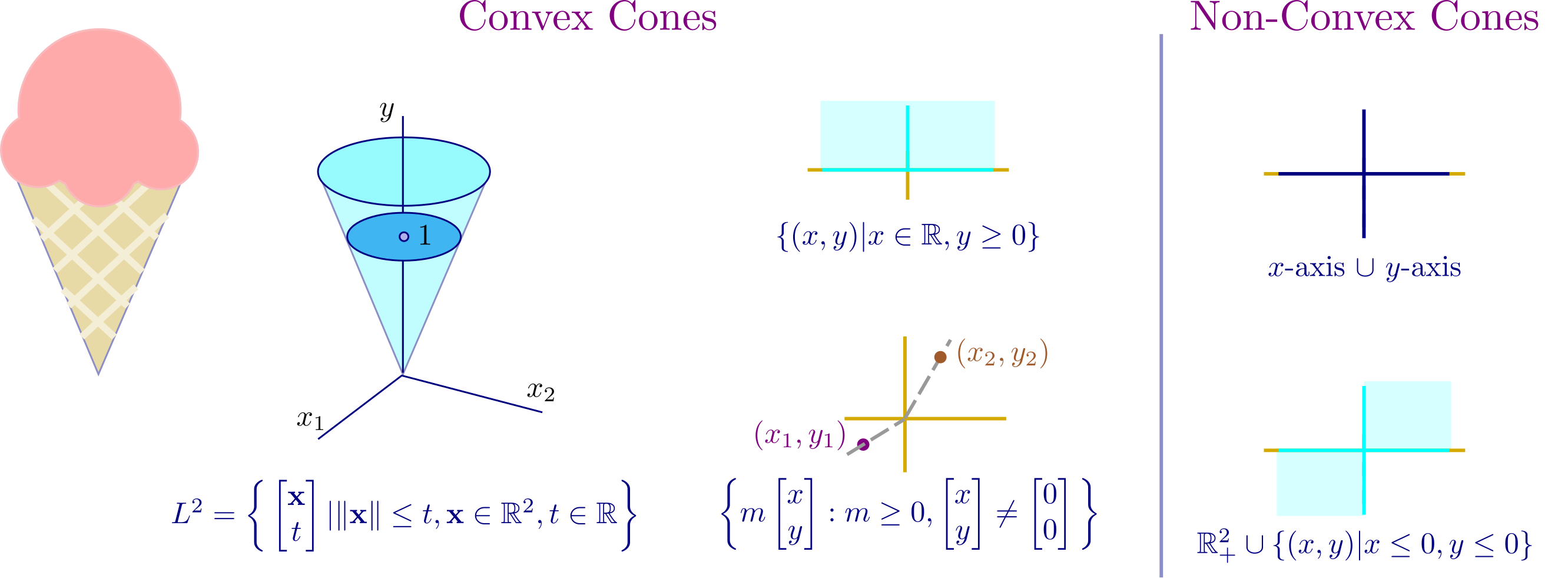
Definition: A set \(S\) is a cone if for any \(\textbf{x} \in S\) and \(\lambda \geq 0\), \(\lambda\textbf{x} \in S\).
Union of cones is a cone.
Intersection of cones is a cone.
(Remember that the union of convex sets is not necessarily convex, but the intersection of convex sets is convex)

Convex Cones#
Theorem: A cone \(S\) is convex if and only if \(\textbf{x}, \textbf{y} \in S \implies \textbf{x}+\textbf{y} \in S\).
Conic Combinations#
Conic Combinations#
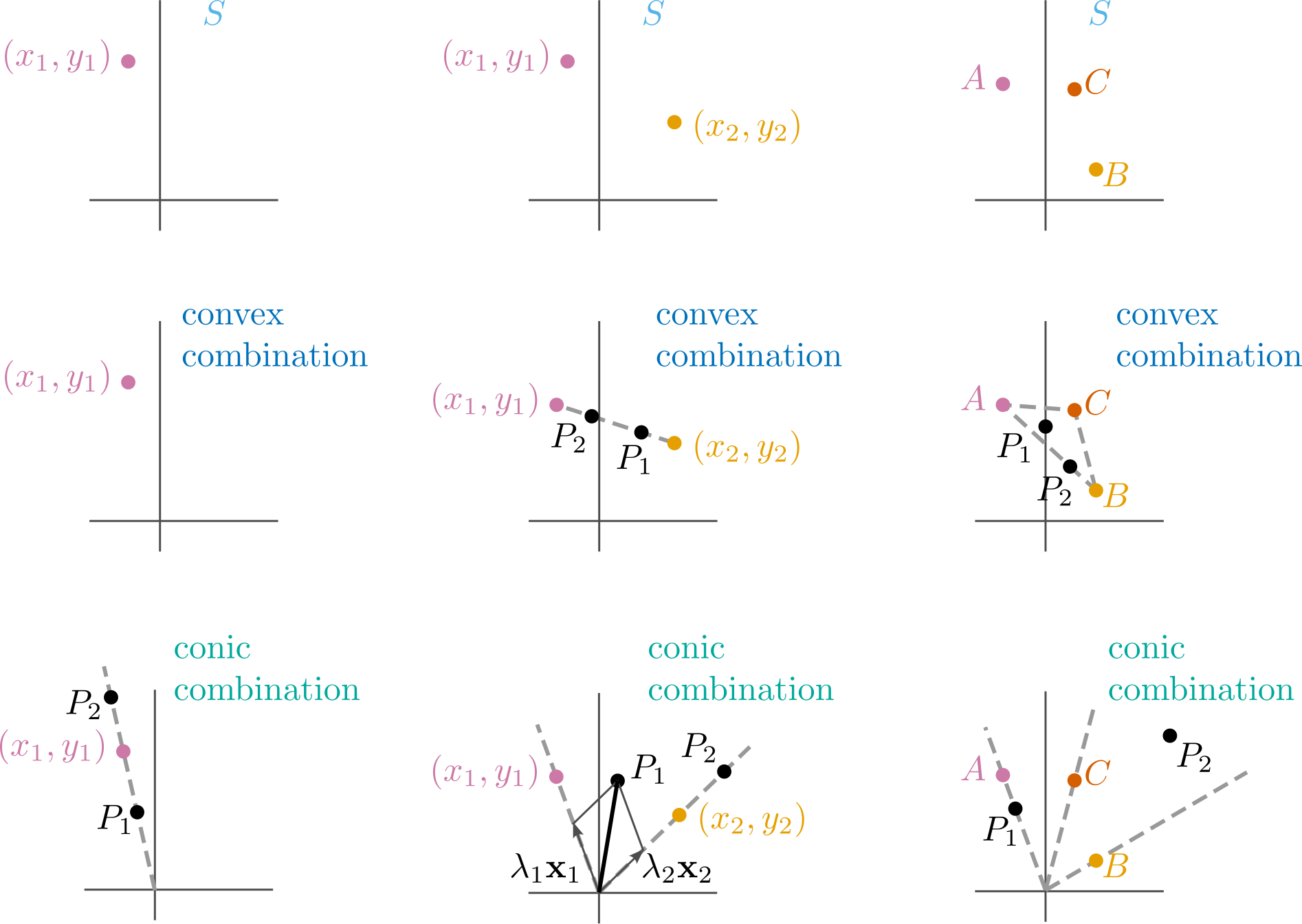
Definition: Given \(k\) points \(\textbf{x}_1, \textbf{x}_2, \ldots, \textbf{x}_k \in \mathbb{R}^n\), a conic combination of these \(k\) points is a vector of the form \(\lambda_1\textbf{x}_1+\lambda_2\textbf{x}_2+\ldots+\lambda_k\textbf{x}_k\), where \(\lambda_i \geq 0\).
This is different than a convex combination because the \(\lambda_i\) do not need to sum to 1.
Conic Combination Examples#
Conic Hull#
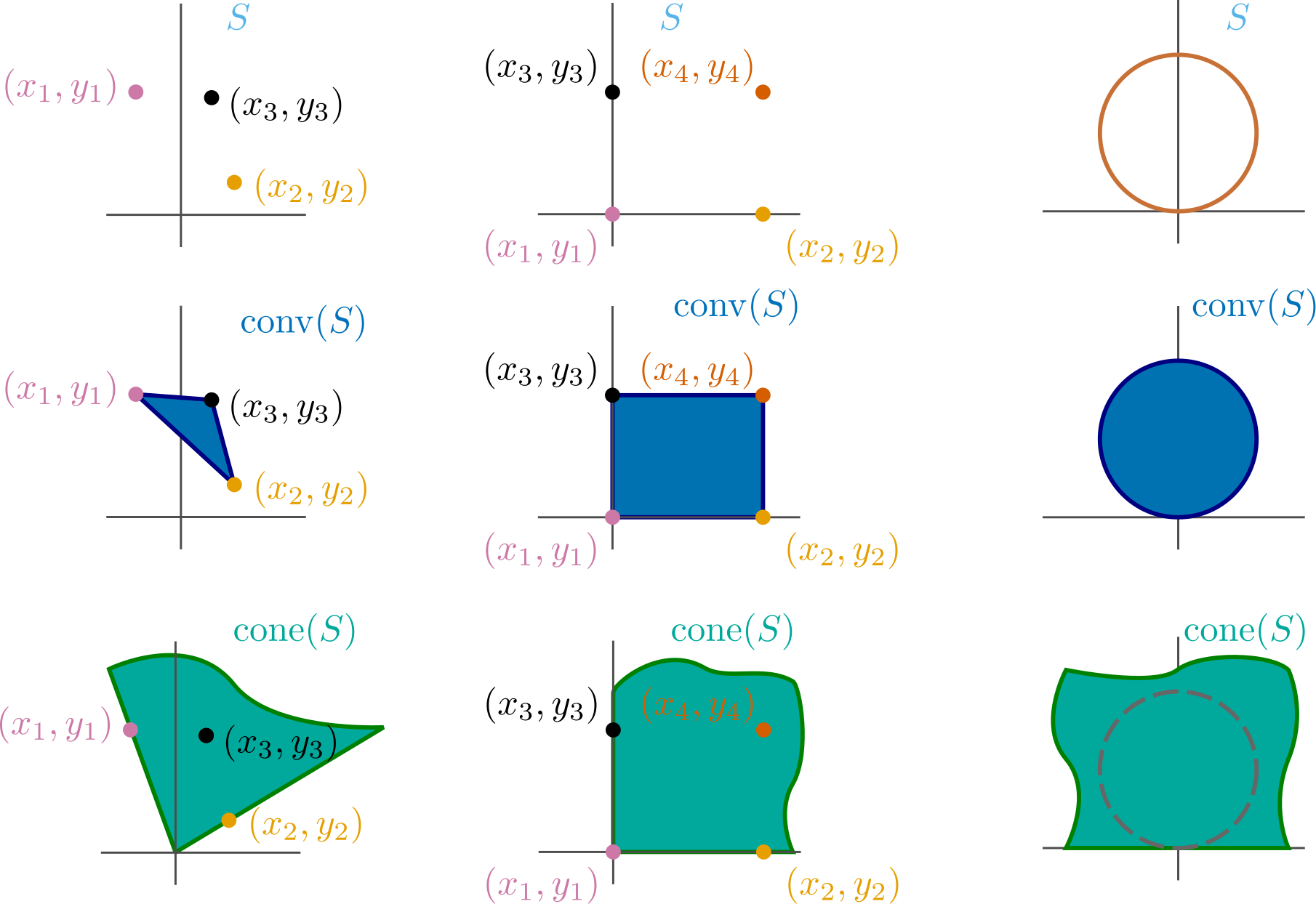
Definition: Let \(S \subseteq \mathbb{R}^n\). Then the conic hull of \(S\), denoted by \(\mathrm{cone}(S)\), is the set of all conic combinations of vectors from \(S\):
The conic hull of a set \(S\) is the smallest convex cone containing \(S\).
For \(S \subset \mathbb{R}^n\), \(\mathrm{conv}(S) \subseteq \mathrm{cone}(S)\).
Conic Hull Examples#
Conic Representation Theorem#
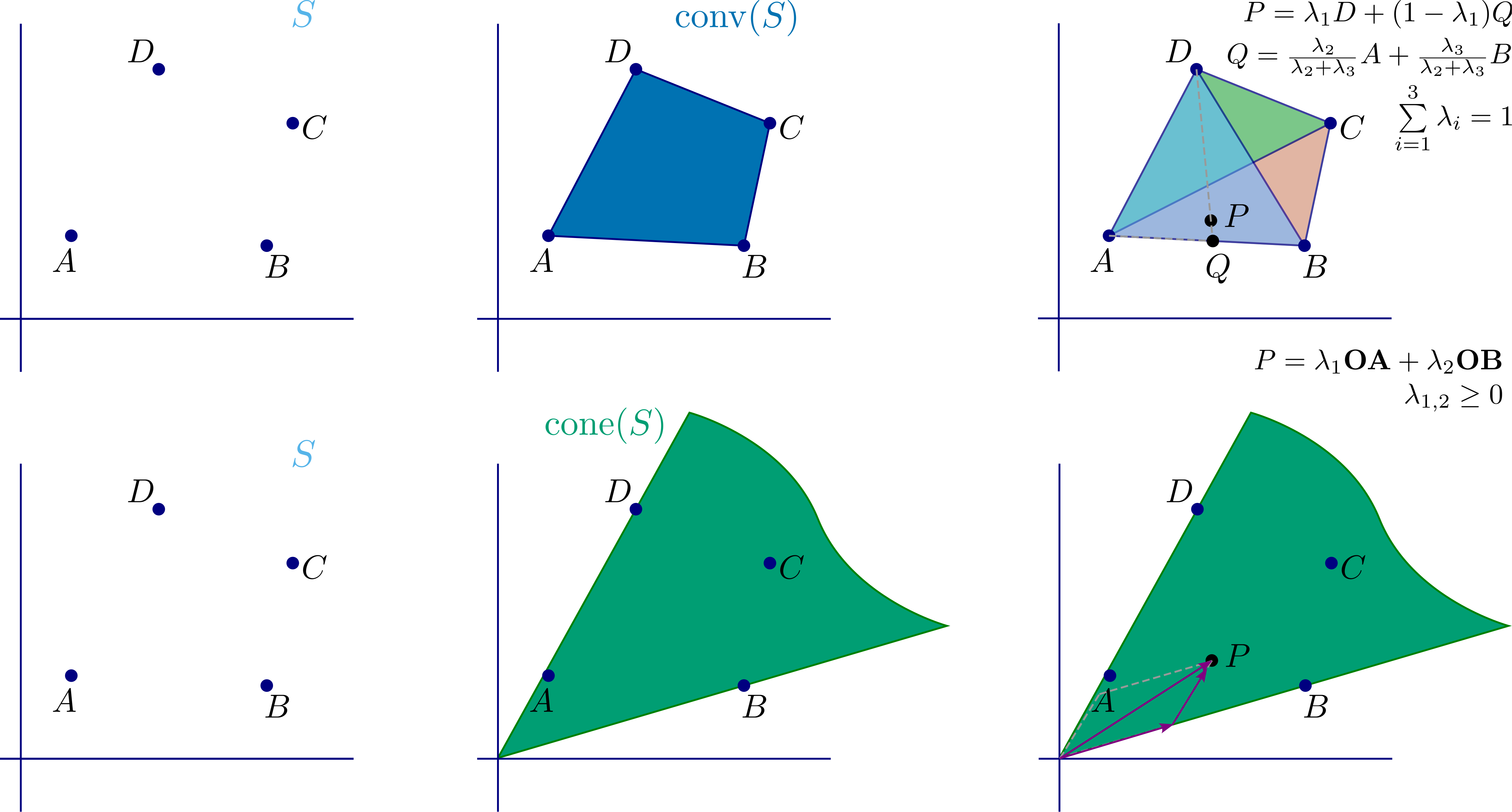
Theorem: Let \(S \subseteq \mathbb{R}^n\) and let \(\textbf{x} \in \mathrm{cone}(S)\). Then there exist \(k\) linearly independent vectors \(\textbf{x}_1, \textbf{x}_2, \ldots, \textbf{x}_k \in S\) such that \(\textbf{x} \in \mathrm{cone}(\{\textbf{x}_1, \textbf{x}_2, \ldots, \textbf{x}_k\})\); that is, there exists \(\lambda_1, \ldots, \lambda_k \in \mathbb{R}\) such that
In addition, \(k \leq n\).
This says that each vector in the conic hull of a set \(S \subseteq \mathbb{R}^n\) can be represented as a convex combination of at most \(n\) vectors from \(S\).
Conic Representation Theorem Examples#
If \(\mathbf{x} \in \mathrm{cone}(S)\), then \(\mathbf{x}\) is the nonnegative sum of at most \(n\) points of \(S\).
If \(\mathbf{x}\in \mathrm{conv}(S)\), then \(\mathbf{x}\) is the convex sum of at most \(n+1\) points of \(S\).
Conic Combination Versus Convex Combination#
For \(S \subset \mathbb{R}^n\):
Conic |
Convex |
|
|---|---|---|
Set definition |
cone: \(\forall \mathbf{x}\in S, \lambda\geq 0 \Rightarrow \lambda\mathbf{x}\in S\) |
convex: \(\forall \mathbf{x},\mathbf{y}\in S\), segment \([\mathbf{x},\mathbf{y}]\subset S\) |
Combination |
\(\lambda_1 \mathbf{x}_1 +\ldots+ \lambda_n \mathbf{x}_n\), \(\lambda_i \geq 0\) |
\(\lambda_1 \mathbf{x}_1 +\ldots+ \lambda_n \mathbf{x}_n\), \(\lambda_i \geq 0\) and \(\sum_{i=1}^n \lambda_i=1\) |
Representation |
at most \(n\) points |
at most \(n+1\) points |
Hull |
smallest convex cone containing \(S\) |
smallest convex set containing \(S\) |