
Generative AI Use Policy Statement for CMSE 202#
Note
As an MSU student, you already have free access to AI tools — Microsoft Copilot is available through your MSU Office 365 account at spartan365.msu.edu and Google Gemini is available at gemini.google.com when you sign in with your MSU Google account. You do not need to pay for AI tools to explore their use in this course.
This course also provides access to HiTA, an instructor-managed AI assistant built specifically for CMSE 202. HiTA is grounded in actual course content and is designed to guide your learning rather than just give answers.
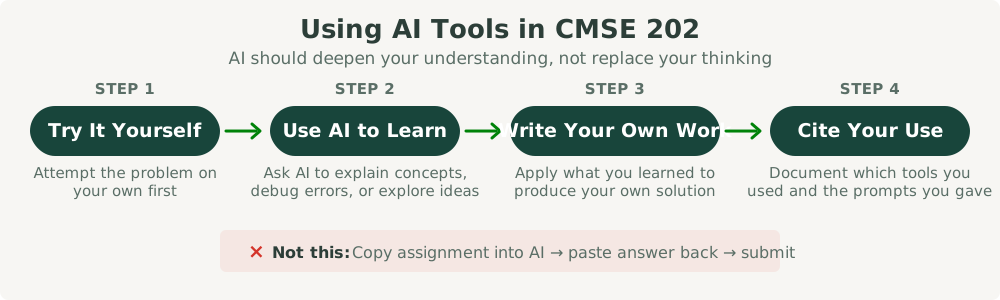
For CMSE 202, the use of generative artificial intelligence (AI) tools (such as ChatGPT, Google Gemini, GitHub Copilot, Microsoft Copilot, Claude, etc.) is welcomed and encouraged. Generative AI represents a fascinating intersection of computing and creativity, offering students an opportunity to explore cutting-edge technologies while honing their programming skills. That said, do not rely solely on AI tools to complete assignments; This will not support the value this course has for your education which include the critical appraisal of algorithms and the ability to break scientific problems into solvable components. AI tools are intended to support learning and deepen understanding, not to simplify or accelerate task completion.
We also want to be clear that the use of AI tools is entirely optional. If you choose not to use generative AI — whether for ethical, environmental, personal, or any other reasons — that is a completely valid choice. No assignment in this course requires the use of AI tools, and your ability to succeed will not be affected by choosing not to use them.
Finally, it is imperative that the utilization of generative AI within this course (if you choose to do so) adheres to ethical guidelines and respects the intellectual property rights of others. As you engage with generative AI technologies, please keep the following principles in mind:
Academic Integrity: When using generative AI tools, it’s essential to attribute the contributions of the AI appropriately. If a portion of your work is generated by AI, be transparent about its influence and contribution to your project. Clear Attribution, Citation, and Prompts: Clearly indicate where generative AI has been used in your project and provide proper citations for the AI tools and models you utilized, along with the prompts you used to generate content. This can be done through comments in your code, annotations in your documentation, or a dedicated section in your homework or project reports. Properly citing both the tools and the specific prompts for each piece of generated content helps ensure transparency, reproducibility, and gives credit to the creators of the AI tools. As an example, see citation at end of this page1.
Ethical Use: Ensure that the generated content adheres to ethical standards and doesn’t promote harm, discrimination, or any form of malicious intent.
Intellectual Property: While generative AI tools can help you create novel content, they should not be used to plagiarize or infringe upon the intellectual property rights of others. Make sure that the content generated is original and properly cited if it draws from existing sources.
Algorithm Understanding: While you may be using pre-built generative AI libraries and tools, strive to understand the underlying algorithms and mechanisms. This knowledge will empower you to use these tools more effectively and creatively.
Experimentation and Innovation: Generative AI offers a unique platform for experimentation and innovation. Feel free to explore unconventional ideas, pushing the boundaries of what’s possible while maintaining ethical and responsible use.
Collaboration: Collaborative projects involving generative AI are encouraged, but all contributors should be credited for their individual contributions. Transparent communication about the extent of AI involvement is vital to maintain the integrity of collaborative work.
Data and Privacy: When using data with generative models, ensure that you have the necessary rights to use the data and are allowed to input data into the generative model. All data use must follow MSU guidelines on Data Uses and Risks of Generative AI. You should not use confidential, private, or any type of custom research data with current generative models.
Learning Priority: While generative AI is a valuable supplemental tool, remember that the primary focus of the course is on computational modeling and programming. The use of generative AI should supplement your learning journey rather than overshadow core concepts.
Given the rapid evolution of generative AI technologies, please note that this policy may evolve over time to adapt to new developments and challenges. We encourage you to stay updated on any policy changes to ensure your compliance with the most current guidelines.
By adhering to these guidelines, you will not only harness the power of generative AI to enhance your learning experience but also contribute to a respectful, creative, and responsible academic environment. Through your exploration of generative AI, you will gain valuable insights into the intersection of technology and creativity, setting the stage for a future where ethical and innovative AI applications flourish.
The policy above applies to daily and homework assignments. The policy for exams may differ from general course use and will be stated in advance of each exam, as it may vary based on the exam format. In any of your work, do NOT rely solely on AI tools. All the work must be your own. Simply copying questions from the assignments into generative AIs and pasting the answers back into the assignments with non-essential modifications are NOT acceptable and may be considered plagiarism in the context of this course.
A draft of the above policy was originally generated with the assistance of ChatGPT1
[1]OpenAI. (2023). ChatGPT-3.5. Accessed from https://chat.openai.com/ on Aug 22, 2023. Prompt chain:{‘write a statement for generative AI use policy appropriate for a college course on computational modeling and python programing’; ‘Add additional information on how to cite generative ai if used’; ‘Add statement that this policy may evolve since generative ai rapidly evolving’; ‘please tighten up list of items’}
[2]Anthropic. (2026). Claude (Claude Code, Opus 4.6). The workflow diagram was generated with the assistance of Claude. Prompt: ‘create a flow chart visual illustrating the recommended AI workflow for course assignments.’